Host: Welcome to CET Talks, the International Accreditors for Continuing Education and Training’s podcast, where we convene thought leaders in the continuing education and training ecosystem to share ideas, research, best practices, and experiences that promote the creation of a world that learns better. Enjoy the episode.
Randy Bowman: Hello, and welcome to CET Talks. My name is Randy Bowman. I’m IACET’s president and CEO, and I’m excited to be here with our leadership track co-host, Mike Veny.
Mike Veny: Thanks, Randy. It’s great to be here with you today. And hello to our listeners out there.
Randy Bowman: Yes, hello everybody. We’re glad you’re here, too.
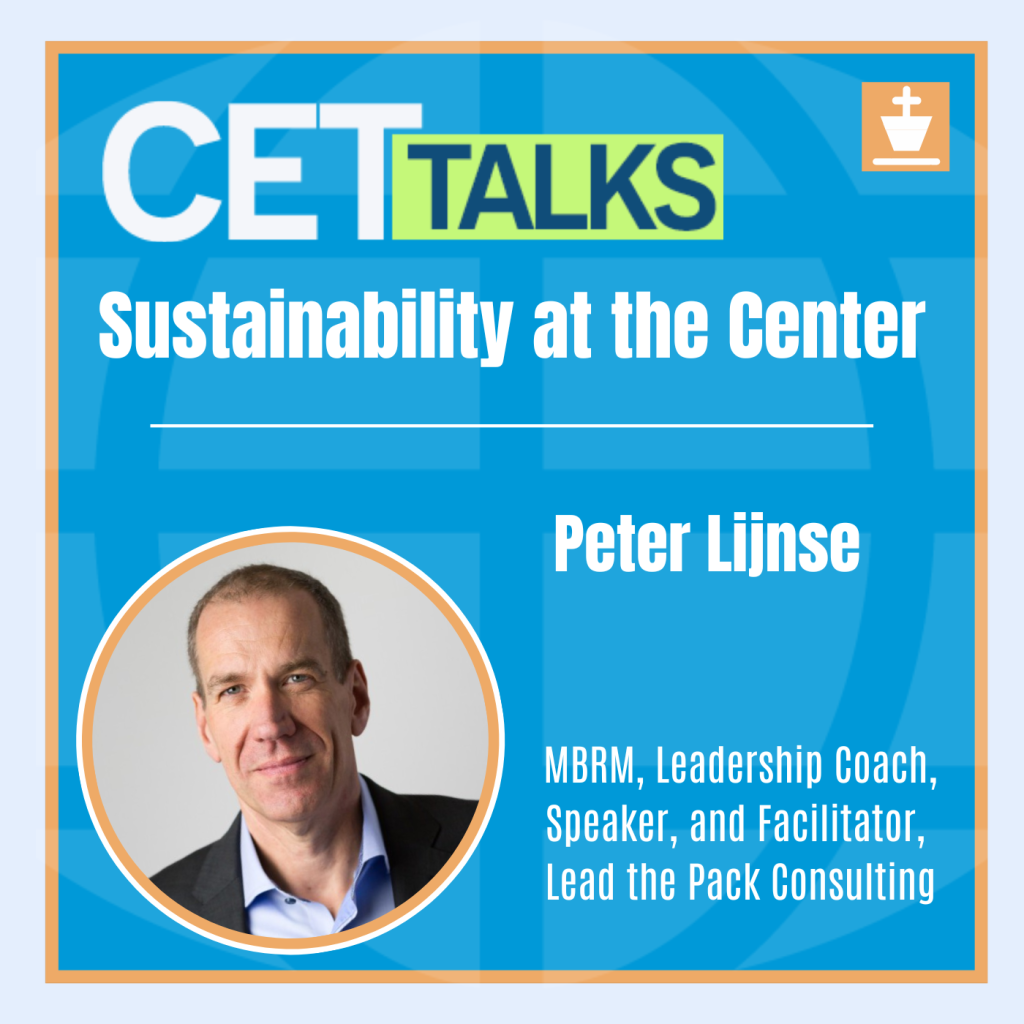
Mike Veny: Yes, we’re going to be talking about business relationship management today, which is a really important topic. If you’re out there listening, and you’re a leader or an aspiring leader, it doesn’t even matter if you’re with a learning organization. I think you need to hear this interview today because we live in a world where relationships at work are having some problems. I’m super excited to have our guest, Peter Lijnse, MBRM, leadership coach, speaker, and facilitator of Lead the Pack Consulting. He helps organizations to develop a BRM, which stands for business relationship management, capability and coaches BRM teams on how to get the most out of their BRM capability. He is the author of several books, the most recent being Hexagon Effect, which is in my Amazon shopping cart right now. We’re going to be chatting about that a little bit more in today’s conversation. Welcome to our show, Peter.
Peter Lijnse: Thank you, Mike and Randy, for inviting me. I’m looking forward to talking about some of these topics. Specifically, of course, my passion for over a decade now is business relationship management, so I’m looking forward to this.
Randy Bowman: Well, we’re so glad you’re here. To kick us off, why don’t you tell us what business relationship management is and how it intersects with sustainability in the training and development space?
Peter Lijnse: It’s interesting. I was thinking about how to describe this easily for people who are in different fields, where they haven’t heard a lot about business leadership management. So, I originally came from IT. I did IT management, and about a decade ago, I started getting interested in business relationship management because a lot of the things that we encountered were that, especially for IT, they’re not really that good at communication. They’re not really that good in action, follow-up, et cetera. So, business relationship management was always an interesting part. How do I get better relationships going between different groups? For me, business relationship management still is a means to an end. I mean, in the end, it’s about results for the organization. The results are important so that we actually achieve our objectives.
Often, when we look at organizations, it’s about getting those results through clear collaboration, and the better we collaborate, the easier it is to get those results. That’s where relationship management comes in. Relationship management is a part of that collaboration. It helps if we have better relationships. Quite often, the interactions are better. I always tell people, okay, think back to a situation where there was a team that worked extremely well together. There were good relationships, where everyone was talking to each other, there was a lot of communication going on, the actions were taken, and you got a great result. But now think about a situation where relationships were not good between the team members, and we saw challenges. That’s where you then start to look at, okay, well, what happened? Quite often, the results are not as good as we thought they would be.
Why? Because we didn’t talk to each other, we missed things. And I think—and you said this already at the start—that this is not just for one group. This is in learning and development, as well. If we want to get clear learning and development approaches, we need to deliver the results from learning and development, and that could be anything from knowledge gain for people, it could be behavioral changes, or organizational conditions. So, the relationships must be good. That’s where I’m coming from. In this discussion, I come from the bias that relationships are the most important thing. I mean, everyone has their own thing that they say, “This is the most important thing.” For me, that is part of that. I think that’s where I want to start with the intersection; if you want to keep that sustainable, it is important to have good relationships.
Mike Veny: I happen to agree with you. Relationships are important. One of the reasons I’m really glad we’re having this conversation is because the Society for Human Resources Management, back in January, put out this statistic that 50% of employees will not talk to another employee with a different worldview. So, I feel like we need what you have now more than ever. And I want to ask you, what is the Hexagon Effect, and how does it help leaders think differently about relationships and interconnectedness?
Peter Lijnse: Well, the Hexagon Effect was something that I wanted to do for a very long time, and that was to write a novel. I wanted to write a business novel. The Hexagon Effect, in this case, is based on some models that are being used within the book itself. But hexagons are kind of interesting because hexagons come in nature a lot. They have six sides, of course, and it is quite often a very good structure. There’s a lot of harmony and balance in there. That was more the idea behind it, to get that going. What I wanted to do after I wrote two books about business leadership management and did a lot of work with the BRM Institute to develop some of their material, I wanted to write a novel about someone who wants to build relationships within an organization. I specifically did organizational white, so it’s a business novel; it’s not a murder, mystery, or horror thing.
It is purely about the boring part of working in an organization and working through that. The hexagons came in because that was one of the methods they used in the book to figure out how all the parts work together. It makes it easy to focus on that. For me, it was just fun to do that because I can tell you that it took over a year to get this done. You get a plot, you start writing, and then your editor starts to change things. It’s a different way of learning. To link it back to learning and development, storytelling is important. I wanted to get myself some experience in this to ensure that I would say, okay, this is how I would tell the story.
This is how the story actually would work. Storytelling is an art, and I think that a lot of people are losing. We don’t tell enough stories or we tell the wrong stories. I hear a lot of people telling stories about how things went horribly wrong and then leave it at that. From a learning and development perspective and any leadership perspective, if you tell a story, it needs to have a way to get out of that situation. It needs to solve something. That’s what I wanted to do with the book, to get with my co-author, Elka Schriver, just to focus on how you would build that business relationship management in an organization. In this case, it’s a medical equipment organization, but it doesn’t matter. There’s some learning and development in there, as well. There are a lot of different methods, et cetera. So for me, it was more a matter of trying to tell that story and how things would actually look. I think that’s, for me, the part of the learning and development, as well. Some people actually need stories, and I think that’s the most important part.
Mike Veny: In your experience, what are some of the biggest barriers that you’ve seen to embedding sustainability into learning and development strategies?
Peter Lijnse: I see more and more that if you want to make something sustainable, it needs to be adaptable. It needs to be quick and be able to pivot. If something is working right now, that doesn’t mean it’ll work in the next year. I think the only way to have that situational awareness of where things need to go, how we need to change, and what different ways we need to do things is we have to look at having the right relationships with the right people so that we hear what is going on and see where we need to adjust. If I look at the past, I mean, you would build a training course, and would have it for five to 10 years, and then someone would say, maybe we should update it nowadays. I built a workshop last year that I’m now reevaluating if it even makes sense to continue in the same way.
It’s like I have to redo it. And I think that is so important, that sustainability and also the understanding within learning and development that through the relationships that we built with our clients, with our colleagues, we hear things and say, “Hey, that’s something that we should add. This is something we should do.” I think that is the complexity we see right now. I always refer back to the nineties, where everything was five-year, 10-year plans, and we knew exactly what we were going to do for the next five and 10 years, which we never actually ended up doing. But that’s beside the point. Nowadays, I’ve worked with organizations where we had something, we did something, and then a half year later it was like, “Hey, you know what? No, let’s do something else.” And we experimented.
I think for me, that’s one part of the sustainability that is important, and that is if you want to build something sustainable, you need to adapt to the organization, and you need to adapt to your target audience, which is very different at this moment than in the past. I mean, this is coming back for the whole neuroinclusion task force, as well. I learned a lot about that. But for me, it was like I didn’t like university; it was way too structured. I just learned through doing things. And that is such a different approach that you have to start thinking about how we can do that. Do we have videos? Do we have different approaches? Can people do self-study? So, the sustainability is the flexibility and the adaptability to the market, I think, and for me, that’s the most important part. You can get that through having good relationships because then you’ll hear what needs to change.
Randy Bowman: That’s great. So, you kind of already addressed the next question I had, which was how do you define sustainability? You’ve answered that with the ideas of adaptability and flexibility, and the ability to be able to pivot. With that in mind, how would a leader build that into the culture of their organization? Because, at least in my experience, you have people who love to adapt and are very flexible, and you have people in your organization who say, “Well, this is the way we’ve always done it”, and they have a hard time with change, adaptability, and flexibility. How do you, as a leader, manage that tension and build that culture?
Peter Lijnse: I think when I’m looking at that—I mean, I hear this a lot. I encounter a lot of people who say, “I need to have a process in place. I need to know exactly these, and these things, and this needs to be there, and everything needs to be predefined. And when I have that, I will be able to do it.” That is one group that is difficult sometimes to get to change. But for me, change is interesting because I think everyone wants to change, but it doesn’t mean that we always know what the change is going to mean for us, and that’s where we get a little bit anxious. Is this a good thing or not? So, I think from a leadership perspective, if you have people who find it difficult to pivot, to change, you need to give them a clear path.
I’ve used, for instance, techniques around storytelling, where you tell the story of what the new situation will look like, and you give them that comfort of knowing, “Hey, this is how it would look in the future; I can work towards that.” So, that’s one approach. I think coming back again to “Let’s talk about it, let’s interact, let’s communicate,” but also I think, and this is an important part of relationship management that I’m working on a lot, is language. How we say things is extremely important, and I’ll give you an example from a leader’s perspective. If I tell someone or a team, “Let’s do this,” your brain will react differently than if I say, “Let’s do this together.” The word “together” actually triggers a different part of the brain; neuroscience has looked into that. For me, that’s so important because it’s the way we frame things, the way we say we’re going to do this.
I mean, how often have you heard of a situation where someone says something and has someone like the intonation, is this now negative or is this positive? I can say, “Let’s do this” in a lot of different ways. “Yeah, okay, we’ll do this.” “Yeah, let’s do this.” “Yeah, I’m excited; let’s do this.” So, we see different reactions from that. I think coming back to your question around how you address that, the people who want to change sometimes are difficult, as well, because they constantly want to change, and they’re constantly chasing new things. You sometimes have to pull them back, and you need to get the groups to work together. I think that is part of business relationship management—bringing different people together in such a way that we can talk about it. I’m currently writing an article on neuroinclusion with relationship management, discussing how you get the right people to talk.
The person who doesn’t want to say anything could actually be a very important part of that. So, a different perspective on this, but I think it’s an important understanding that as a leader, to give a little bit of the summary on this, as a leader, you need to be able to adapt to different styles, pull different people in, interact with different people, but also clearly communicate what the new state is going to be. Then you can get people to buy into that. I just want to say one thing here. A lot of organizations look at organizational change, and organizational change is quite often in transformational elements, and it’s a huge change. I fully understand that that is important, but leaders in day-to-day work are doing as much change as those big programs. I work more with those types of situations where we say, “Okay, can we change something within this specific element?”
Mike Veny: Well, speaking of bringing different people together, I’m going to ask you a question, but I’m going to frame it in a certain way. Since you brought up this whole thing about framing questions, I want to ask as though I am resistant to what I’m going to ask and see what you can say to convince me. I’m really not resistant, just for the record, but why do you believe, actually not how do you believe, but why do you believe inclusive and accessible training design is essential for long-term organizational health?
Peter Lijnse: A lot of organizations are changing faster. We see timeframes are shorter, and things are more complex. It’s not just one thing that happens; it’s a lot of different things that are happening, and clear paths are very difficult to find. We might have an idea where we want to go, but the journey towards that is not always easy. One of the things around being inclusive is that if we do not include different perspectives in our decision-making or in our approaches, what we will encounter is that we miss certain perspectives and, due to the complexity, we miss that completely, or we have our own biases. That means we don’t get the best approach for the organization. So that’s one thing. Being inclusive can help us to find those different perspectives, which makes it easier to solve complex situations; in complexity, we have to have diverse views.
There’s no other way to solve this. We quite often need to do experimentation around that as well. But the world is not just like, if I do this, then this automatically happens. Things change, and I think there are people in the organization who see those symptoms, see those signals, and would say, “Hey, based on that, I don’t think this is going to work.” If you don’t include those people in your learning and development, I think you’re going to miss a significant part. Now, besides that, I think we have a tendency to develop towards the average person and the neurotypical person, which is not there. I mean, everyone has elements that are different. I think if we develop for a larger audience, everyone will be able to pick up on that and drive that.
So for me, the inclusion is important. So I’ve worked with teams, for instance, in organizations where you have people who are quiet during meetings, and you try to pull them in, and you sometimes are surprised by the type of information they have seen and how that can help you to become better. I think that’s what part of the relationship management is, and that’s why I’m so excited about neurodiversity. I understand from a learning and development perspective, for me in the relationship management, that to get people to understand that we need to talk to each other, we need to just stop. I’ll give you one example. If you talk about bike lanes in cities, you will get people two opposing things. A couple of years ago, here in the city I live in—this was early days of Twitter—and there were two people.
One was opposed to bike lanes, and the other was for bike lanes. They were arguing with each other [on Twitter], and it didn’t look good. Eventually, they said, “We live in the same city. Why don’t we go for coffee with each other?” And after that coffee that they had together, they actually saw each other’s viewpoint, and they started to help each other. They still had their disagreements, but in a totally different way. I think this is part of our inclusion. When you have face-to-face meetings, when you get people to be pulled in, that is going to be an important part.
Randy Bowman: Thank you, Peter. That’s so insightful. I love that idea of in complexity, we must have diversity. Wow. I’m going to be thinking about that one for a bit. But as we wrap up, we really like to ask all of our guests one last question, and that is, what does a world that learns better look like to you?
Peter Lijnse: When we learn better from each other through building relationships with each other, making sure that we connect with each other, that we communicate, that we talk about our different perspectives, that we value our different perspectives, we will see better results because it’s easier to get to that. A world that learns better, I think, comes back to communication with each other. And then the actions following that. I mean, we can communicate, but if we don’t follow up, then the trust is gone, and that doesn’t help. So there are a lot of trust elements in there. Then one last thing, I think, around building trust in learning, I normally use the trust triangle, and authenticity is important in the relationships. Logic is important in relationships, and we quite often have a tendency to build on that, especially in learning and development. We want to be authentic, but we also want to have logic. I think we need to always look for empathy, empathy in there for different viewpoints, and making sure that even in learning development, we can do something that is maybe not suitable for everyone.
Randy Bowman: Well, Peter, thank you so much for delivering an engaging and informative presentation for us today. This has been a whirlwind of so many deep concepts, and I’m still trying to process them all. One of the things, I think, that really struck me from our conversation, though, is the challenge to shift our mindsets that sustainability and business are about creating adaptable relationship-rich ecosystems where learning inclusion and strategic alignment are at the core. I loved the reminder that leaders drive transformation not only through the grand initiatives, but through the everyday conversations, and that those have to be backed by stories. I love stories. Stories are so important, but those stories can’t just be about problems. They have to be about solutions. So, I guess if we want sustainable change in our organizations and in our learning environments, we need to start telling those stories that clearly describe the better world we’re building. Mike, what about you?
Mike Veny: Well, I’m writing a lot of notes over here; a lot of eye-opening moments here. It’s interesting because I value relationships. It’s one of my top values, and at the same time, I value systems in my business. I never really connected the two like I have today, and I still have to reflect on this, but the importance of relationships as a part of sustainability in the organization. So, I learned a lot. And as we wrap up today’s discussion on business relationships and management, we would love to hear from you out there. If you’re listening, let us know—how are you building your business better? Are you focusing on growth, new content, or taking a more renewable approach to your future success?
Randy Bowman: And don’t forget that you can submit topic ideas, suggestions for guests, review our archives, and much more at the CET Talks website, available at cet-talks.org. Don’t forget to subscribe to this podcast on your favorite platform so that you don’t miss any of these engaging episodes. Thank you, listeners, for joining us. Thank you, Peter, for joining us. And thank you, Mike, for being here today.
Host: You’ve been listening to CET Talks, the official podcast of IACET. Don’t forget to subscribe to the podcast on Spotify, Apple Podcasts, or wherever you listen to podcasts. To learn more about IACET, visit IACET.org. That’s I-A-C-E-T.org. Thanks for listening, and we’ll be back soon with the new episode.