Host: Welcome to CET Talks, the International Accreditors for Continuing Education and Training’s podcast, where we convene thought leaders in the continuing education and training ecosystem to share ideas, research, best practices, and experiences that promote the creation of a world that learns better. Enjoy the episode.
Randy Bowman: Hello, and welcome to CET Talks. My name is Randy Bowman, IACET’s president and CEO, and I’m so excited to be here with our leadership track co-host, Mike.
Mike Veny: Hi Randy, and hello to our listeners out there. I am the CEO of an IACET-accredited provider. Today is a very important episode, Randy, because right before we started hitting ‘record’ about half an hour ago, I was on the phone with a friend who works in HR but doesn’t have any real certification. They’re telling me now they’re going back to school, and they’re struggling with seeing if some of their past experience can be used for credit. I’m excited about our episode today because we’re going to talk about learning that counts, credit for prior learning, and the future of adult education.
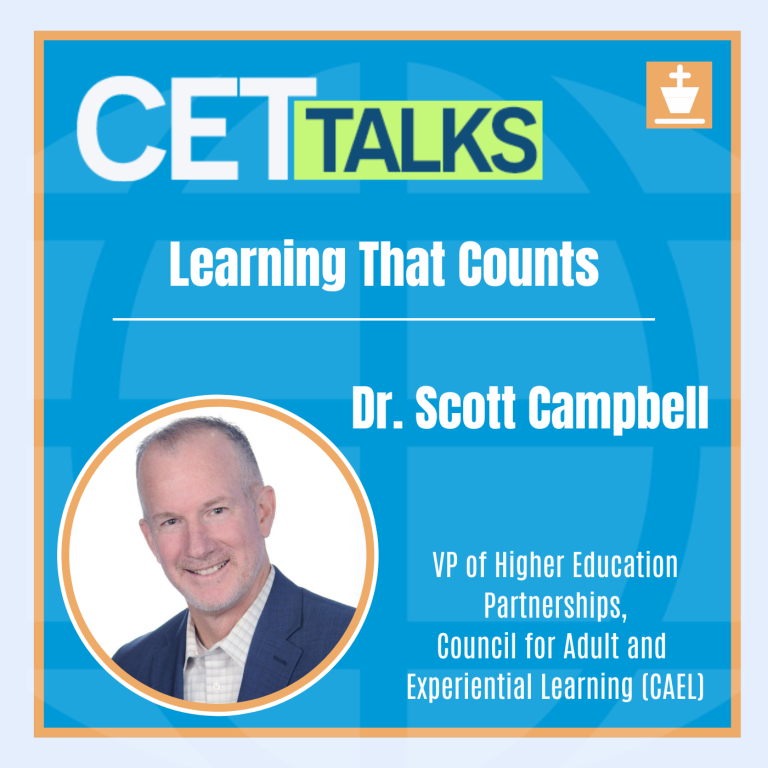
Our guest today is Dr. Scott Campbell, Vice President of Higher Education Partnerships, Council for Adult and Experiential Learning (CAEL). Scott brings over 20 years of leadership experience in adult learning, credit for prior learning, which you’ll hear the term CPL here, and post-secondary innovation. He’s the former dean and program leader at Edgewood College and Regis University with a track record for growth and veteran advocacy. He leads national partnerships focused on helping institutions respond to the evolving needs of working adult learners. Welcome to our show, Scott.
Dr. Scott Campbell: Thanks so much, Mike. Thanks, Randy. I really appreciate you having me.
Randy Bowman: Mike, I think you mentioned the story of your friend, Scott. Why don’t we jump in? Can you tell us exactly what credit for prior learning, or CPL, is, and how we define what counts as prior learning in today’s educational landscape?
Dr. Scott Campbell: It’s a good question, and one that probably should be a simpler answer than it is, but credit for prior learning is the awarding of academic credit for college-level knowledge. It generally is given for things like work experience, military training, industry credentials, advanced high school courses, AP and IB courses, those types of things that can be considered credit for prior learning. More and more, we’re seeing different types creep in, like workplace training and things like that.
Mike Veny: Can you describe what CPL looks like in practice at higher education institutions that are doing it well? But more specifically, here at IACET, we’re always talking about measuring things. So, I’ve got this prior knowledge or experience. How do we measure that? Because when you’re dealing with an academic institution, everything is measured by the credit and stuff like that.
Dr. Scott Campbell: It’s interesting because while more than 88% of the colleges out there have some form of credit for prior learning, they’re often very disaggregated. It happens in corners of campuses and within departments, but not very systematically. It’s sometimes difficult to know what’s going on, who’s being exposed to the idea of credit for prior learning, who’s actually using it, and overall, what impact you’re having. What are the metrics that say, “Hey, we’re moving the needle here.” At CAEL, we’ve been around for 50 years doing this work. We have over 700 institutions that are part of our membership. The best ones make the process very transparent, and it happens early on in the process, whether it’s the admissions process or the early advising process. You have advocates or advisors who are confident and conversant about the process, and who can share and shepherd them through that process, because when adult learners are coming back to school, they’re often very uncertain of themselves.
By definition, many have had some traumatic experience at a college before, and so the best programs do shepherd them through that process with knowledgeable advisors and a system that’s very clear and transparent.
Randy Bowman: It’s pretty evident that credit for prior learning is very beneficial to the learners, but why is this something that higher institutions are increasingly adopting? It seems almost against their own self-interest to give students credit when they could make them take the classes. What is the strategic value that it offers the higher education institution, as well as some of the non-apparent advantages for the learners?
Dr. Scott Campbell: It’s interesting you said exactly what many faculty say that we’re going to lose money if we do this; if we give away credit, it’s not in our best interest. I’m going to have fewer opportunities for my faculty to teach, and we’re going to earn fewer tuition dollars. Actually, the students who do credit for prior learning actually end up taking more credits in residence than those who don’t by a long shot, on average, 17.6 more credits, which is really a full semester plus. So, we try to demystify with the research what some of the things folks often ask, which is, “Hey, why do this? ” The reason why we would say that colleges and universities should do this is that it benefits in terms of persistence, it reduces the time to degree for students, and that persistence might be counterintuitive, but if they’re given a clear pathway to the end line, then they’re more likely to follow that to the end.
There’s great promise here of closing equity gaps as well, and I know we’ll probably talk about that, but I think whether it’s Hispanic students, Black students, community college students, Pell recipients, all of those groups, the research shows that they can benefit from this. Colleges and universities that have student success as a goal should really look into credit for prior learning.
Mike Veny: I love what you said, and you talked about something that we don’t talk about a lot on this show, and that’s the client that we serve. When you do something like this as an institution, you increase the trust the student has in the university and also their opportunity to engage with the university. They’re going to want to be there now. They’re going to want to invest more. I really appreciate you saying that. Speaking of equity gaps, especially for learners who have skills and knowledge but lack formal credentials, what can you say about how CPL can be leveraged specifically to close those equity gaps?
Dr. Scott Campbell: Well, we have some really clear research. There was a study done by CAEL and WICHE, which is the Western Intercollegiate Compact on Higher Education, I think it is the acronym. But that research looked across a seven-year period with 250,000 students and tracked on that. We’ve found that, as I shared before, students can benefit regardless of race or economic status. And so colleges and universities that want to have those learning outcomes and have their students complete at a higher level, it makes a lot of sense for them to think about credit for prior learning.
Randy Bowman: That’s great for higher education. We’re glad to see that they’re adopting these practices. Now, most of our providers here at IASET are, well, they’re non-credit providers. They provide continuing education, professional development, and training. Why should training providers who are outside of higher education also be paying attention to credit for prior learning?
Dr. Scott Campbell: I think there’s been an explosion and a recognition that people learn in all kinds of places, at their own pace, in all kinds of ways. I think the opportunity for non-credit providers, folks who are doing industry trainings, national certifications, and employer trainings, is that there’s some good learning that’s happening there. At CAEL, we help colleges and universities with their capacity for how to do credit for prior learning; we do trainings with faculty on how to assess non-credit to credit. We also do technical assistance, where we can do it for them, and they can bless the assessment that we do. I think more now than ever, non-credit, whether it’s training, LinkedIn learning, Amazon, we’re seeing Project Management Institute, all kinds of different opportunities that are historically not credit-bearing. We’re seeing colleges and universities interested in that kind of partnership and alignment because that can create pathways to their programs and, in doing so, potentially reduce the cost of student acquisition in the recruitment of those potential students.
Randy Bowman: As a follow-up, what specific actions can a non-credit training provider take to partner with their local universities or colleges to help their learners get credit for the accredited training they’re taking with our providers?
Dr. Scott Campbell: We’re actually engaged in that kind of process by helping bring people to the table. We actually do things with the energy industry. We’ve been doing it for 25 years, where we take these industry partnerships, and we bring together energy leaders and identify what their learning needs are. We’re aligning their workforce development needs with the learning outcomes of those trainings. And I think that’s where the opportunity is. I think the more alignment you have, the more effective you’re going to be between the entity of the college and university learning outcomes and the workforce development needs of that potential industry. That’s where that connection happens. That’s largely what CAEL does quite a bit of is bringing those stakeholders together so they’re speaking the same language.
Mike Veny: Thank you for answering that, and Randy, thank you for asking it. Randy and I have worked together for a while, and this is the first time I can say he read my mind, and he asked the question, and I’m like, “But that was my question.” I think for the training providers listening out there, this is a really important thing, but you said something that I want to reiterate. It starts with assessing learning needs, right? Then we can figure out how to get there, whether it’s going to be through a formalized continuing education course or using that in addition to prior experience that someone has. But let me ask you this—how does CPL intersect with larger movements around workforce development like micro credentials and stackable learning pathways?
Dr. Scott Campbell:
It’s interesting, just a couple of weeks ago, I was at a conference between AACRAO and UPCEA. UPCEA is the University Professional Continuing Education Association, and AACRAO is the American Association of Collegiate Registrars and Admissions Officers. Those two organizations have a long history, but they decided to get together and create a conference called Convergence. Convergence is talking about this innovation and the credentials that are happening. While the four-year degree is still the predominant credential, stackable credentials and certifications, and all those different types of things are becoming more pervasive and more widely accepted when they’re done well. I think that intersection of these larger movements has a long history, and in the last 10 or 12 years, it has become much more, I’d say, widespread. Folks who are doing competency-based education at a scale rather than…competency-based education used to be something that was more like clear learning outcomes that could be demonstrated, and every course should have clear learning outcomes.
But I think now with Southern New Hampshire and the Wisconsin Competency Flex program, those different programs are seeing how the scaling of competency-based education as a movement can fit in nicely with credit for prior learning, micro credentials, stackable credentials, and industry certifications.
Randy Bowman: For our listeners who really want to dig deeper into this topic, because we only have a little bit of time, where can they go to learn more about credit for prior learning and the impact it can have on their adult learners?
Dr. Scott Campbell: Well, I think I want to promote my organization, CAEL. We’ve been doing this for a long time, the Council for Adult and Experiential Learning. Throughout the year, we are doing professional development workshops. We have over 5,500 members who are engaged in this type of work. We have special interest groups, affinity groups that are related to credit for prior learning, which are related to stackable credentials, folks who are interested in these different movements that work hand in hand with one another. There are a couple of other organizations, and I briefly mentioned them: the CBEN, which is the Competency Based Education Network, and then UPCEA and AACRAO. You can see how the registrars are very engaged in this work because of how to put this on a transcript and a diploma, which coincides with another movement, which is on the learning records (LER) , and where students communicate what they know and can do. And that really comes down to how do we put this on credentials? Do we just put it on LinkedIn, or do we have something more official?
Mike Veny: In so many ways, you’re opening up a can of worms for me.
Dr. Scott Campbell: It is a can of worms. There’s no doubt.
Mike Veny: I know this is not a consultation for me personally, but I’m going to ask this question for myself. Randy kind of asked this before, but I just want to go a little deeper here. And for any of the providers listening, this is an important question here: what methods are typically used to assess and validate CPL, and how do they differ across institutions?
Dr. Scott Campbell: Different institutions have different missions, so if you think about credit for prior learning, where are most of the credits coming and going? It relates to military students. The military folks who are coming home have some processes; the American Council on Education (ACE) has taken all the military training and done some assessment of how many credits each of them is worth. I think other institutions have taken that and done crosswalks to the learning outcomes of specific courses. That can help the student go beyond just elective credit because nothing frustrates veterans more than coming home, getting 40 credits, but they’re all elective, and they don’t get you closer to the finish line. So we’re finding that the opportunity to do that is clear.
Other ways folks are getting credit are through credit by exam—CLEP, Dante’s, UXL, all are different opportunities, language proficiency—that’s kind of low-hanging fruit in terms of credit for prior learning. So you have folks that are speaking different languages. Sometimes they’ve taken the proficiency exam for that language, but that can also be very helpful. And more and more, we’re seeing things like apprenticeships and workplace trainings be opportunities for credit for prior learning. I think the most labor-intensive one is Portfolio. Portfolio is something that we at CAEL have specialized in over the years. It’s more of an individualized assessment, and the students reflect on that learning as it relates to the learning outcomes of a specific course. In doing so, if they can get through that process, which can be—it’s not a cakewalk by any means—but by getting through that process, their likelihood of persistence and completion grows much stronger.
Mike Veny: Well, thank you for that answer right there. I hope those of you listening took some notes on this one. Here at IACET, we always like to end our podcast on one final question: What does a world that learns better look like to you?
Dr. Scott Campbell: From my perspective, a world in which we learn better is more connected and more integrated. There’s greater alignment between needs and outcomes. So often, when somebody revises a course or something like that, it can take years. We know change is happening at unprecedented rates, especially with artificial intelligence. So that alignment of those learning outcomes, if we get better at learning, we’ll do a better job of that. I think folks with clarity around their own mission, I think we’ll do a better job of ignoring less and have greater recognition of learning overall. I think we can be more responsive if we do a better job of integrating and aligning our learning. Then also, I think, especially as it relates to the context of higher ed, I think we’ll do a better job of holistically supporting students in ways that we haven’t in the past.
I think there are some good models out there. Western Governors University has done a really good job of supporting its students through what was originally a self-guided study that is now more holistic, and the completion rates have gone through the roof. I think that for me, that’s how the world will look a lot more connected and integrated.
Randy Bowman: Scott, thank you so much. This has been so informative about this very important topic on ensuring that learners get credit for their experience. Actually, my key takeaway here is that yes, there’s hard work to be done, but this isn’t just a policy issue. It’s much deeper than that. It’s a human one. It really is about dignifying people for the learning they’ve done, whether that’s through hard work, their service, or their experience. I think when our institutions come together, and we treat that learning with respect and transparency, we’re not just helping people move faster through the system, we’re affirming that what they’ve done matters and that it counts. What about you, Mike? What was your takeaway?
Mike Veny: Well, as a provider who has to do strategy for my organization, I have to have a very long meeting with myself over coffee to go over all the notes that I took, and I’m definitely going to be listening back to this episode and taking notes again. One thing that actually stood out to me was the importance of reminding people who have prior knowledge and experience that there’s so much more to come for them, and that it is valuable, and organizations and institutions are starting to recognize that more. I think it’ll give a lot more people hope. That’s what I got from it.
Dr. Scott Campbell: Yeah, I sure hope so. I think it can be very powerful to be heard, to be seen. In a college environment, when folks are coming back from the military or from an experience where they struggled in higher ed, having people who are listening to what they’re bringing and validating that can be very powerful.
Mike Veny: Well, as we wrap up today’s discussion on learning that counts, credit for prior learning, and the future of adult education, we’d love to hear from you. What kinds of learning do you think should count for credit, but often don’t in your field?
Randy Bowman: Don’t forget that you can submit topic ideas, suggestions for guests, review our archives, and more at the CET Talks website, available at CET-talks.org. While you’re there, don’t forget to subscribe to this podcast on your favorite platform, so you don’t miss any of these informative episodes. Thank you so much for joining us today.
Host: You’ve been listening to CET Talks, the official podcast of IACET. Don’t forget to subscribe to the podcast on Spotify, Apple Podcasts, or wherever you listen to podcasts. To learn more about IACET, visit iacet.org. That’s I-A-C-E-T.org. Thanks for listening, and we’ll be back soon with a new episode.