Host: Welcome to CET Talks, the International Accreditors for Continuing Education and Training’s podcast, where we convene thought leaders in the continuing education and training ecosystem to share ideas, research, best practices, and experiences that promote the creation of a world that learns better. Enjoy the episode.
Randy Bowman: Hello, and welcome to CET Talks. My name is Randy Bowman, IACET’s president and CEO, and I am excited to be here with our leadership track co-host, Mike.
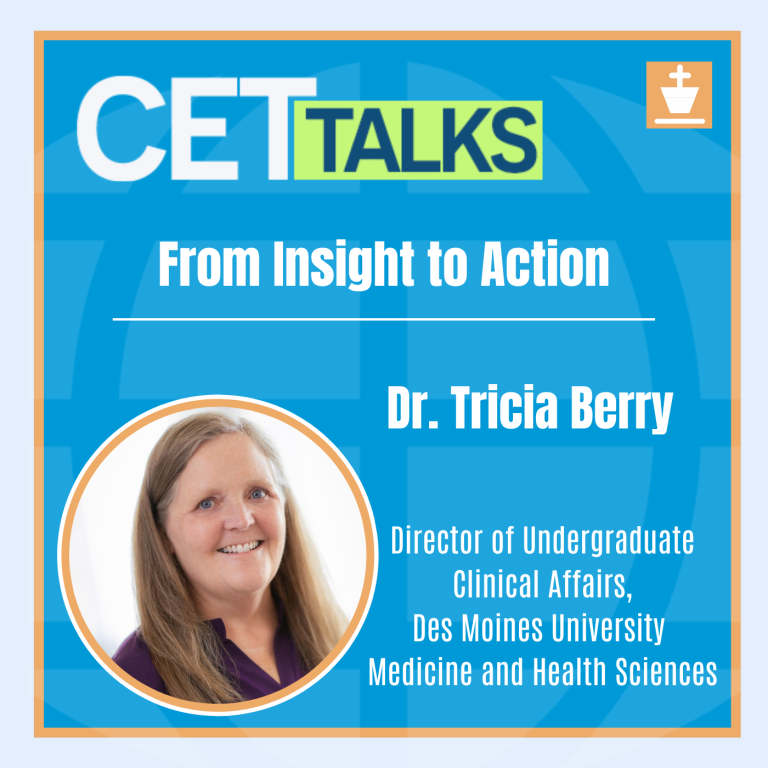
Mike Veny: Hi, Randy, and hello to our listeners out there. Randy, I’m excited for today’s guest because I have a complaint I’d like to make on air. We’re going to record this; everyone’s going to hear it. Sometimes we get some wonderful guests. We get wonderful experts in all different disciplines on these shows, but sometimes we’ll hear something and theoretically, that sounds great, but how do you really apply it? I’m excited for today because we have with us Dr. Tricia Berry, Director of Undergraduate Clinical Affairs and President of AAACE. We’re going to be talking about going from insight into action, moving theory to practice in today’s workforce pipeline. She has over 30 years in healthcare and adult education with degrees in educational leadership, teaching and learning psychology and occupational therapy, led course and program design, supervised clinical placements, and established online placement policies across disciplines and global contexts.
She’s an active member and presenter within organizations such as AAACE, ILA, UPCEA, and others with global speaking experience in Europe, the US, and South Africa. Trish, welcome to our show.
Dr. Tricia Berry: Thank you. It’s always humbling to hear that and a little overwhelming, but thank you.
Randy Bowman: We’re so glad to have you with us today, Trish. You’ve worked in both clinical education and the broader workforce development for over two decades. In that time, how has your view of the adult learner evolved throughout your career?
Dr. Tricia Berry: That’s a wonderful question, and I had to really think about this. I think in the beginning, I didn’t think much about the adult learner. I started teaching randomly, and I just knew I was going into the classroom, and I had to teach anatomy. I wasn’t really thinking about the learner in any way, shape, or form. I was thinking about how I was going to teach content. I think those early days of teaching, I was thinking more about myself and how I delivered information. I wasn’t thinking about the learner at all. I was, but more, how am I going to get this information to them? Over time, and I think this is true of anybody who goes into teaching, you gain experience, and you realize you have to start thinking more about the learner and less about your content and how you’re delivering it.
I think that my view of learning has changed over time. When I first started teaching, I taught the way that I was taught. You stand up in front of the room, and you spew a bunch of information and expect people to learn it. I learned over time that maybe that wasn’t all that effective. I did a degree in teaching and learning and then a degree in organizational leadership. I learned much more about how to work with individual people rather than thinking about the content you’re delivering, if that makes sense. The content’s important, but how you connect it for the people is even more important. Obviously, we know now from research that education is much more about active learning than the types of learning that many of us experienced. I had great college experiences and wonderful instructors, but we know now that people who engage with material, interact with the material, and have experiences learn more deeply and in better ways, and that learning is very relational.
I think that’s probably a piece that a lot of folks miss. Your relationship as the instructor with the student can carry you a long way in helping a student to learn. Being able to form those relationships and have students know that you’re there, you’re present, that you care about them, and you care about the materials you’re delivering is a really important piece of being successful in the classroom. I think this is particularly true with adult learners.
Mike Veny: So many of us started out with just wanting to put our content out there and teach it the way we were going to do it. I think this is a path that many of us go through. What’s also interesting about this is learning is constantly evolving, right? Like what we’re talking about today in two years might be irrelevant, but for today, let’s talk about the adult learner for a second. What are some of the most important characteristics that, in your opinion, distinguish adult learners from traditional students, and how do these show up specifically in healthcare education?
Dr. Tricia Berry: Yeah, also great questions. So, the obvious answer, and if you’ve done any research and reading about adult learning or listening to podcasts and other venues, adults bring life experience. So when we talk about traditional learners, typically we’re talking about that K-12 or maybe even your more traditional college education, that 18 to 22, 23-year-old. They are lovely and wonderful, but they don’t have the kinds of experiences that our adult learners have, both within professional venues and then also in life. The experiences that our adult learners come from are sometimes helpful in the classroom and can sometimes be an asset, but also sometimes can detract.
One of the parts of your question was about how do students bring this to the healthcare classroom? When I was back teaching on a ground campus years ago, one of the courses I taught was the diseases of the human body course. In my first class, I would hand out the syllabus and we talked about the syllabus. I also did a spiel about we’re going to learn about a lot of diseases and how they impact a lot of body systems over the course of this material. We’re going to have to temper our temptation to talk about every disease that every person we know has ever had and how that impacts them. I used to say this to my class. Now keep in mind, I had good relationships with them before this happened. So this wasn’t like the first time they were ever meeting me, but I would say to them, if your aunts, uncles, cousins, dog’s, husband had this disease, that doesn’t mean that they had the same experience as everyone else with that disease.
So when you go into healthcare, you have to remember just because you’ve had an experience with something doesn’t mean that that’s the norm and doesn’t mean that we need to share all of that with every member of the class every week. I used to tell them, “If we do this, we will never get through our content.” We talked some about what’s good sharing and what’s not good sharing, in terms of what we’re talking about in the classroom because there were things that students had to share that were meaningful. Part of that was an unintentional lesson in teaching them about being discerning as a healthcare professional, what you share, and what you don’t share because that’s a professional skill within healthcare. Both the benefit and the danger of students coming in with life experience is that it could be used to go either direction. One of the things, especially in healthcare, you have to be careful of is not generalizing your own experience to assume that it’s everyone else’s experience.
I think in healthcare too, adults can bring a different level of compassion that younger folks who have not had as much life experience may not have. I can think of a lot of things that I did early in my career as a healthcare professional that now that I’m a little more older and seasoned and have had children and been through a few life things, I probably would’ve handled those situations really, really differently. I won’t tell the stories and out myself, but I think it is something that our adult students can bring to a situation as even an entry-level healthcare professional because they’ve had some of those life experiences already. They maybe have a different way of relating to the patients and to the situations the families are in.
Randy Bowman: That’s so insightful, Trish. So insightful. One of the key defining characteristics of adult learners is that they’re coming to you with life experiences, both professional and personal. That obviously has some kind of trade-off. That also means they’re coming to you with competing priorities. They have family, maybe full-time jobs, maybe other caregiving roles that they’re in that they’re trying to balance with their studies. How do you as a facilitator, an instructor, and leader of a team approach supporting these individual learning journeys that are dealing with real life complex realities?
Dr. Tricia Berry: Yeah, there’s not one right answer to this question for sure, because every situation is different. And yes, our students come with a lot of background and experiences and things, again, that could be both good and bad. They also come to the classroom with some biases based on their life experiences and whatnot. I think the number one thing in working with us is getting to know your students. I talked a bit ago about establishing the relationship. I think the best way you can help these students is by understanding them. Now, again, that doesn’t mean you need to dive into every detail of their personal life, but showing some care, trying to understand their past experiences and have compassion for them.
Then, I think institutionally, you obviously have to create structure. In academics, we have to have some structure, guidelines, and benchmarks for when students are successful and not successful, particularly in healthcare. Our students are going to go out and impact people’s lives in potentially very serious ways, so we do have to have some benchmarks and guidelines for the students. But also within that structure, there has to be flexibility for those competing priorities that they’re having to manage. I think if you take the time to get to know your students and to understand what’s happening with them, that helps you determine how to handle those difficult situations. As an example, if you have a student who isn’t turning work in on a regular basis, rather than just assuming that they’re disinterested and a slacker find out what’s going on, reach out, ask questions, and have interactions with them the best that you can. Often, you’ll find out they’ve got a sick child, a sick parent, or they’ve been sick, they’ve been laid off from a job, or they’ve suddenly taken on new responsibility, and now they’re working a 60-hour week instead of a 40-hour week.
Finding out those things about them helps you create some flexibility within your work with them and have an appreciation for what’s going on. I think a key piece of that, too, is knowing what supports are out there for those students. When you take the time to find out what’s happening with them, you can pull those support services in. Even if you as an individual instructor can’t assist, if it’s somebody who’s in a housing crisis, maybe you could get them connected with a group that can help them with that or with a student affairs team that can help them with that.
If they’re somebody who has recently become homeless and doesn’t have even a place to live or to connect to do their work, again, getting them referred to the right people to help support them because if people aren’t stable and safe within their situation, it’s very difficult for them to learn. Those are dramatic examples. Those are really extreme examples, but if you can help those folks that are in those extreme situations, helping the folks that are in less extreme situations is pretty simple and it’s using the same technique. It’s just getting to know them, understand what’s going on, and then being able to help them work through what that is. At the same time, that doesn’t mean that you have to change your benchmarks and your standards, and if they need extra support or they’ve got something going on, it may mean that they are successful or not successful in your course, but I think it’s important to separate that from the person and the human side of things and communicate to them, “You know what? You’re in a tough spot. Things are too far into this course that you’re going to be able to salvage, but I still want to make sure you’re taken care of. I still want to make sure you’re okay, so let’s do what we need to do to set you up for success in the future when you retake this course or when you redo this assignment, so that you have the foundation you need to be successful next time around.”
Mike Veny: This is great. I love everything you’re saying, talking about learning being relational, and at the same time, you have to have this line to discern. I want to ask this quick follow-up question to this for someone who’s like, “Well, how do you do that? ” I know the answer to this is its own workshop or semester of workshops, but for someone who’s involved in education, an instructor who’s new to this, what tips do you have for striking that balance between being relational and yet keeping that standard? Or is it just a dance that you have to figure out along the way?
Dr. Tricia Berry: I think it’s a little of that. I mean, I think experience tells you that you have to learn to trust your gut. Also, I think there’s not a hundred percent right answer. In these situations where you’re working with students and you are doing your best to be supportive, it’s not always going to go right, you’re going to make mistakes, and you’re going to do something that if you look back on it, you won’t do it again. But I think that’s okay as long as you’re within your legal and ethical guidelines; that’s always a requirement. But if you’re erring towards something because you’re trying to help the student, is that really wrong? I mean, you may learn some things from it.
The other thing I think is for new instructors to try to find somebody who can mentor them and help them. Have a person, preferably within their own institution or their own learning environment to say, “Hey, here’s the situation I’ve got. This is what I’m thinking. What do you think? ” Or, “Here’s what I want to do.” Those group thinks or having someone to bounce something off of can be really important. If you have a team around you and all of that team is working with the student, sometimes you’ll have a situation where you think everything is very sincere and you should pitch in and help the student. Then when you start talking to other people, you hear, “Yeah, they did that to me two semesters ago, and this is their fourth grandparent that’s died,” and those kinds of things. So having people around you who you can talk through situations, maybe you learn from the team; it’s a hard balance to not be suspicious and to be supportive.
Also, I think giving yourself permission to come out on the short end of the stick sometimes when you make those decisions, as long as you’re not doing anything that violates legal and ethical guidelines and you’re maintaining that academic standard, it’s okay if you get it wrong.
Mike Veny: Thank you for answering that. With your experience in clinical education and your involvement in organizations like AAACE and IACET, how do you see the adult learners needs evolving now, but also in the future in both academic and professional settings?
Dr. Tricia Berry: Yeah, boy, so much. I like to tell people, I went to college shortly before the dinosaurs became extinct, and we had to dodge them to get to class. That was back when you still had chalkboards even, and a lot of people don’t even know what those are anymore. The way that we deliver services has changed; I don’t think it’s changed as fast as our learners have changed. The world is changing so quickly right now, and there’s tons of stats out there about the fast pace of how things are changing and new information being created and things like that. I think that necessitates our learners making sure that they’re adapting to things. The days of being able to go to college and get a two year or a four year, even a master’s degree, and then use that information to have an entire career are pretty much gone in most professions. I don’t know of any profession that you’d be able to do that.
So our learners are going to have to adapt and change. All adults are going to have to do that to be able to stay with whatever’s happening in their professions. It becomes something that’s not a ‘nice to have’ any more in terms of professional development and moving forward. It becomes a, ‘you have to do it in order to stay relevant in your career’. I don’t know that that’s so much about the learners changing as it is about the world changing around them. So, the learners have to figure out how to function within that world. I don’t know how much people have actually changed, but I think they’ve had to adapt to the world and the things that the world presents.
The other thing that I’m pretty passionate about is access to education. One of the things that has changed in the world is that access. So again, when I went to college, when the dinosaurs were just leaving the planet, people pretty much went to college, you got your degree, and then you moved on. And in a lot of cases, traditional students went to college right after high school, and then you didn’t go back to school again. Part of that was because of locations, and you had to go to a campus to do your learning, especially in higher ed. With online education, all the digital resources, and things we have now, there’s so much more opportunity for people to learn without having to completely upend their lives, having to give up weekends or nights to go to classes, and things like that. So I think, and this again is more about the world changing than the learners changing, but it gives the learners good opportunities to access information and to learn new content and new skills without having to disrupt their lives.
I think especially the younger generation, kids that are just coming out of college now or maybe going into college, they’re going to demand that and expect it. They’re not going to want to have to give up nights and weekends for three or four years to go to classes to earn a higher level degree. They’re going to want to do it while they live their lives. I think that’s probably one of the big changes that has happened for learners is that we’ve gotten learners in the habit of being able to have on-demand content, which is amazing and awesome.
Randy Bowman: Trish, thank you so much. It’s hard to believe that we’re almost at our time. I have six more questions I want to ask you, but I’m going to go ahead and present to you the question we ask all of our guests. What does a world that learns better look like to you?
Dr. Tricia Berry: I’ve heard you ask this question before, Randy, when I listened to the podcast, and it’s fun to have a chance to answer it. I think a world that learns better is a world that creates learning spaces that honors the needs of all learners at all levels. We do have a tendency in academia to get a little hoity-toity about stuff, and I don’t care what a person’s learning. If they’re learning something that’s considered a low-level entry task, and if they’re learning and bringing something new into their lives, that’s just as important as someone who’s doing PhD research. I think we have to respect those levels of learning and honor that for every single person because a traditional message is more that some people are worthy of education and some are not. I don’t think that’s the case. I think everybody is worthy, and everybody can learn. It’s just at different levels with maybe different skills or tasks. I would really want the world to be able to honor that and to respect all learners where they are in their journey.
Randy Bowman: That’s so beautiful. I love what you’re talking about, and I do believe that that kind of passion will create a world that learns better. Thank you for sharing your experiences with us today. I think we’re all going to walk away a little richer. I loved the idea of it’s not just what we teach, it’s how we connect it to the learner that makes that lasting impact. The idea that learning isn’t transactional, but that it’s deeply relational has, I think, been a common theme through our conversation today. Thank you so much for that reminder that it’s the human connection, not necessarily the content that is relevant to activate that learning that we want to see in our learners. Mike, what are you taking away from today?
Mike Veny: Well, same as you and that delicate dance that we all need to do between keeping the humanity here and maintaining the standard at the same time, and figuring that out with staying within legal and ethical guidelines. And so as we wrap up today’s discussion from insight to action, moving theory to practice in today’s workforce pipeline, we’d love to hear from you. What does success look like for the adult learners you serve, and how does your organization help them get there?
Randy Bowman: Don’t forget, you can submit topic ideas, suggestions for guests, review our archives, and more at the CET Talks website, available at cet-talks.org. Don’t forget to subscribe to this podcast on your favorite platform so you don’t miss any episodes. Thank you for joining us. Thank you, Trish, for joining us, and thank you, Mike, for being such an awesome co-host. Have a great day, everyone.
Host: You’ve been listening to CET Talks, the official podcast of IACET. Don’t forget to subscribe to the podcast on Spotify, Apple Podcasts, or wherever you listen to podcasts. To learn more about IACET, visit iacet.org. That’s I-A-C-E-T.org. Thanks for listening, and we’ll be back soon with a new episode.