Host: Welcome to CET Talks, the International Accreditors for Continuing Education and Training’s podcast, where we convene thought leaders in the continuing education and training ecosystem to share ideas, research, best practices, and experiences that promote the creation of a world that learns better. Enjoy the episode.
Randy Bowman: Hello, and welcome to CET Talks. My name is Randy Bowman, IACET’s president and CEO. I’m excited to be here with our accreditation track co-host, Tamiko.
Tamiko Ogburn: Thanks, Randy. It’s great to be here with you today. I’m Tamiko Ogburn, and I’m one of the learning and design managers with the City of Detroit. The City of Detroit is also accredited with IACET, and I have been a commissioner with IACET for over four years.
Randy Bowman: Tamiko, we’re glad you’re here. Tamiko, coming from the technology side of education, I’ve learned that technology platforms are a lot like coworkers. They all have different jobs, personalities, and competing priorities, and sometimes they don’t communicate unless a manager steps in and makes them do it. So, one of our jobs, as educational technologists, is to break down those silos, bring the team together, and focus their expertise on the bigger picture. We’ve got to make sure the technology stack does the same thing.
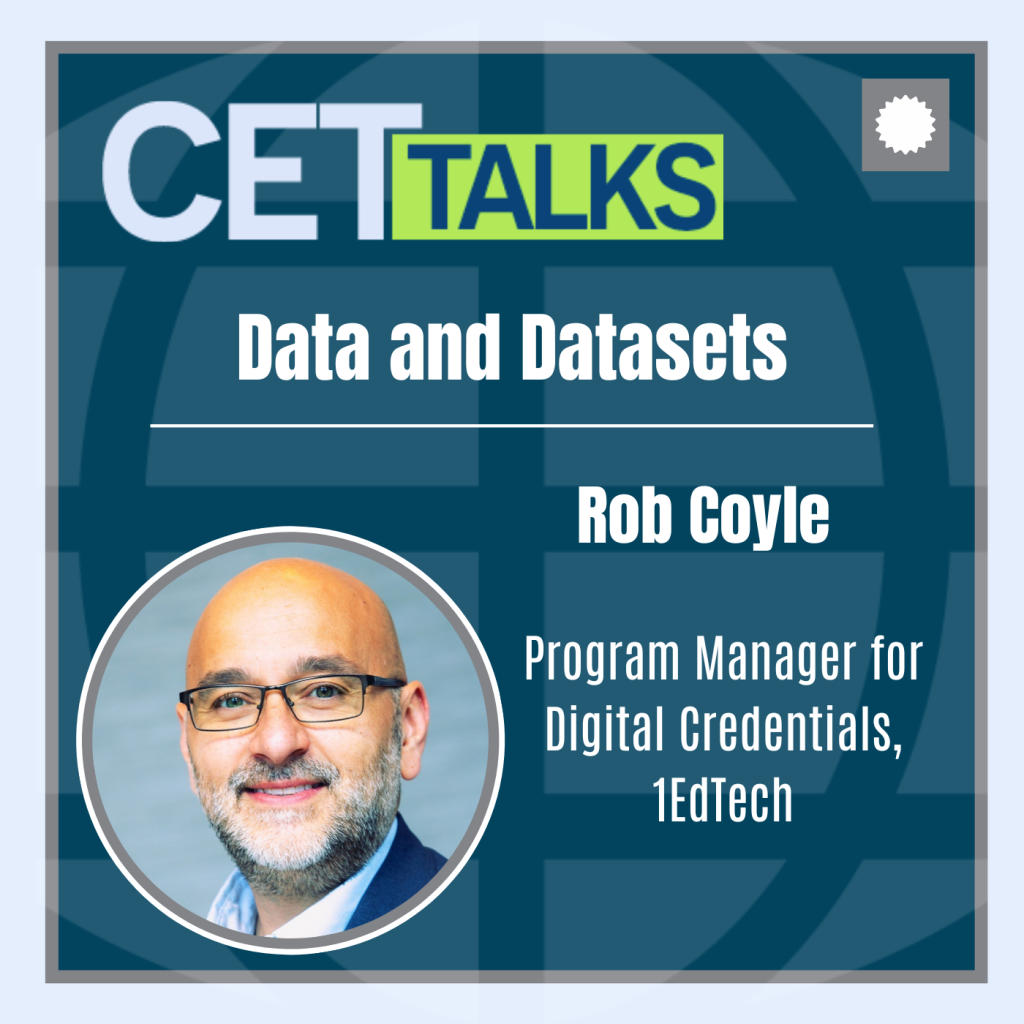
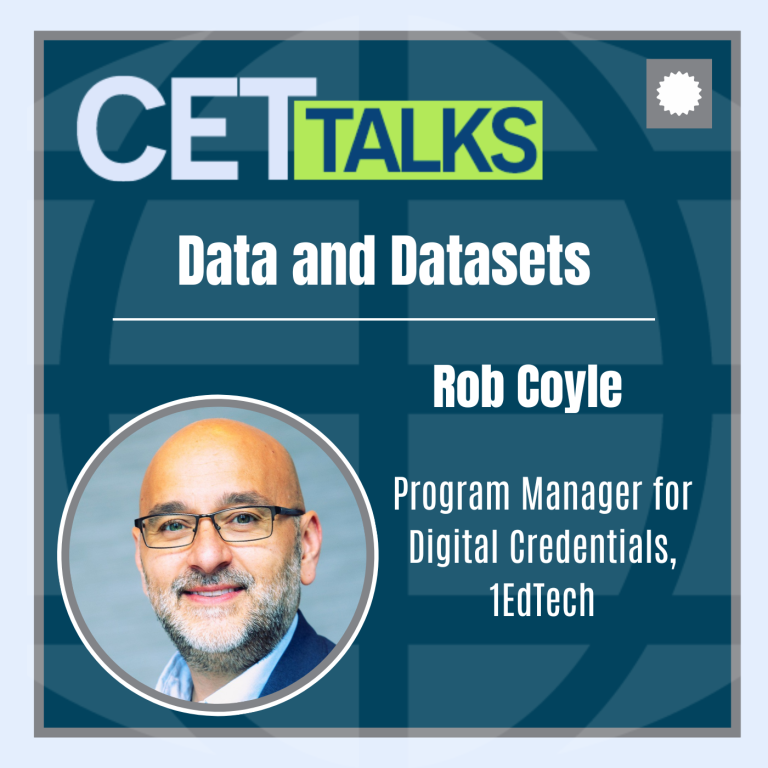
Tamiko Ogburn: I agree with that, Randy. I think that’s why we have a very important guest with us today. Our guest today is Rob Coyle, and Rob is the program manager for digital credentials at One EdTech. He’s committed to advancing open badges and the comprehensive learner record standard to support diverse learning pathways. He brings a background working with K-12, higher education, and corporate training to improve educational collaboration. He’s also a strong advocate of open educational resources and non-traditional learning methods grounded in his experience as an educator. Well, welcome, Rob.
Rob Coyle: Well, thank you. It’s great to be here. Appreciate the opportunity.
Randy Bowman: Rob, I’m really excited about today and so glad you’re here. To kick us off, for someone new to the ed tech infrastructure, what should they know about how platform choices affect compliance, reporting, and learner experience?
Rob Coyle: That’s a great question. You alluded to it about trying to get those coworkers to talk to each other. We talk a lot about interoperability, which is a great way to start a conversation. The analogy that I like to use is you’re traveling to different parts of the world with differently shaped electrical sockets. The electricity is there, but sometimes, without those custom adapters, the electricity isn’t going to flow. So, to your question about platforms specifically, not all platforms are created equal. You want to avoid ones that are going to lock in your data or make it very difficult to extract it, and you want to be sure that your tools work together. It doesn’t necessarily always happen as smoothly and seamlessly as we would like, especially when we have different coworker systems that have their own personalities and talk their own language.
This is where open standards come in. The consortium that I work for, we develop open standards that help these systems speak together and help the data flow between them. That’s going to help to solve your portability, your security, and interoperability across systems in general. You also mentioned compliance and reporting. This is where you need that data, the automation, and the reliability of the data to flow through them. Before you choose a platform, ask if it supports recognized open standards because that is going to directly impact your learner experience and your bottom line.
Tamiko Ogburn: That’s one great question to start off asking. How does a shared vocabulary between platforms help drive better decisions at the organizational level, like learner records, credential metadata, and outcome tracking?
Rob Coyle: I guess in the previous question we talked about technology interoperability, but now you’re asking about semantic interoperability. We need to speak the same language. When we’re speaking different languages, you’re not able to get the outcomes, the credentials, the data records defined in the same way, and we need that. Consistency of all of that language, it helps to reduce the errors and enable the automation that’s going to save us time and money. That ultimately simplifies the reporting process across the board. So, one of the scenarios that I talk about here is often around dual enrollment or transfer, either between institutions, districts, or training providers and institutions. There are a lot of different ways to build that scenario, but ultimately, you need to both understand what this learner can do, who this learner is, what they’ve learned, what they’ve accomplished, and the shared vocabulary is how we’re going to do that.
Not to beat the same drum, but this is where open standards come in because we help to predefine some of those vocabulary terms that we can use. It makes that exchange of data a lot smoother.
Tamiko Ogburn: Yeah, that’s very helpful, Rob. I am one of the faculty members who teach dual enrollment, so I understand where you’re coming from.
Rob Coyle: Yeah.
Randy Bowman: Rob, I’m all about beating the same drum when it comes to data vocabulary. So, let’s talk a little bit about how platforms can align with standards, like the ones written by OneEdTech or IACET, to help bring structure and coherence to an otherwise fragmented tech stack.
Rob Coyle: Yeah, fragmented tech stack; that’s something that we are all seeing everywhere in all of our…
Randy Bowman: We have to live with them.
Rob Coyle: We have to live with them, right? We can do better, at least make them able to talk to each other. We all have student information systems, learning management systems, assessment tools, credentialing platforms, and there’s a lot of different patchwork of systems out there. In many cases, they all require custom integrations. There are custom adapters to get the electricity to flow, and that costs time and money. I’m sure you know, sometimes those custom integrations can be kind of brittle. It doesn’t take too much—one platform updates, the other one doesn’t. Now your integration is broken, and you’re trying to scramble at the last minute to make those changes; time and money again, plus it could be a diminished student experience if the technology doesn’t work.
So, both of us are standards bodies. We like standards, and they help to adopt plug-and-play capabilities. It makes sure that we’re all working together, that we’re all speaking the same language, and that the data is seamlessly flowing across systems.
Tamiko Ogburn: Well, that’s important that you said that, when you talk about speaking the same language, because that will be an issue when you lack that type of interoperability. Speaking of that, what’s an example of how the lack of data interoperability has caused problems for a training or credentialing provider, and how that might’ve been avoided?
Rob Coyle: I mentioned that sometimes those custom integrations break, that the interoperability no longer is there for a variety of reasons, and that can be timely and costly. It can diminish student experiences, create a lot of frustration and headaches as you’re scrambling because, of course, these things will happen in the middle of the night when all your students are trying to access the courses, and they can’t get to anything. It can be a real problem, but it can be avoided. The thing is, if you don’t have smooth-flowing data, then the person becomes the integration layer. You’re going to have to hire someone to do that work. I hear all the time from folks who are trying to download spreadsheets, upload CSV files, create custom tables to marry the data together, and it’s inefficient. It introduces a lot of errors.
We’re human, we’re going to make mistakes, and that can undermine the trust and reliability of the data. So not only is it a diminished experience that might cost you time and money, but now you have to question your data. That, again, is going to cost time for someone to go through and revalidate all of that. We have standards that can help make those connections a lot more reliable, help automation, and that’s going to reduce your cost, save your time, and strengthen confidence in your data.
Tamiko Ogburn: Thank you for that.
Randy Bowman: That’s so important to remember. We all talk about making data-driven business decisions, but if your data is unreliable, you’re going to make wrong decisions on that data.
Rob Coyle: Exactly. What’s the old adage from computers—garbage in, garbage out? If you’ve got bad data, then you cannot use it to make those data-informed decisions.
Randy Bowman: One of the things we run into is that so many accreditation standards were written long before digital ecosystems even existed. What opportunities do you see to update standards to reflect the needs for interoperable, data-transparent platforms?
Rob Coyle: I think many of those accreditation standards were written before digital ecosystems were even imagined, let alone existed. We’re trying to modernize everything, and I think there are opportunities in the accreditation space to modernize not just the accrediting of courses and instruction, but the data infrastructure as well. Can we validate that we are creating portable, verifiable, trustworthy data systems, and that those are in place? I think there’s an opportunity there, and this is where embedding some of those requirements around interoperability, data privacy, and accessibility. Honestly, it’s a place where IACET can help raise the floor for providers in increasing that long-term value for every individual learner.
Tamiko Ogburn: That leads me right into my question. How can we ensure that learning activities, assessments, and credentials are not only recorded but also portable, verifiable, and useful to learners across systems and industries?
Rob Coyle: Recording data is one thing, and that has a lot of value for the institution, but how does that data have a lot of value for the learner? What can they do with that data? I don’t know about you, but credentials I have are often in the form of paper certificates or diplomas or a transcript that’s probably shoved in a drawer somewhere that I would have a hard time finding if I had to. This is where we can use modern technology standards like open badges or comprehensive learner records. There are other standards like competency and academic standards exchange case or Caliper that captures learner interaction data.
We can document all of this in a way that makes that credential move across systems and enables the learner to take that data with them. So, not only is it recording the activity or the completion in some way, but if we can add extra data to bring more meaning and context. Things like evidence, rubrics, criteria, and performance data; they don’t fit on a paper certificate, but we absolutely can create a digital record and give that to the learner to use. The other benefit is that not only does all of that contextual information help someone who’s evaluating the credential—say an employer, institution, or another provider—to understand what a person did, but in our modern structure, we also want machines to be able to consume this data and understand it.
That’s where both technology and semantic interoperability come back in. We can all make sure that we’re speaking the same language and develop our systems to speak the same language so that the learners have portable and verifiable contextual recognition of their credentials that they can then use how and where they want.
Randy Bowman: So true, Rob. I especially like how you started to bring employers into this. We’ve been talking about interoperability of the learning management tools that an educational facility and provider might have, but it goes beyond that. How do I transfer my skills into my employer’s human resources systems? I foresee a day when resumes no longer exist. I often say some of our greatest fantasy authors are writing resumes. How can digital credentials and interoperability help us get past that where we can, as employers and as employees looking for jobs, better connect skills that we have with the skills employers are looking for?
Rob Coyle: There’s a lot in that question. Let’s talk about resumes first. I’m not sure that I would say that I think a resume is going away, but I think a one-page paper-based resume is going away. We’re always going to be curating our data, employment, education, and skills, and resumes should be tailored for the individual job that you’re applying for. We can do all of that with our digital records of this, but we can also bring in so much more information—the evidence, rubrics, and the performance data—and we can package all of that. Ideally, we’ll be able to share this with our employers and not just the hiring manager, but the HR systems themselves as part of the application for a job. Or maybe it’s an application for a higher education degree or whatever the case might be.
Being able to share that data and have it automatically ingested into the HR systems or applicant tracking systems, that is a huge time and cost savings. I don’t know if you all have had to apply for a job or for college, or know anybody who has recently, but I’m watching my kids as they have to upload their transcripts, and then they have to retype all the data again anyway. Why are we doing that? We have better technology. We know how to do this, and when we can get these systems to all adopt open standards and speak the same language, we’re going to save everybody a lot of headaches.
Also, thinking about the human benefits of it, not just the time and the cost savings to the organization, but as someone who is applying for a job. I need to move quickly. I don’t want to wait six months while you figure out your internal systems, do background screenings, and wait for my college registrar to mail a paper to you. We can put all of this in our systems and move this data quickly, and that’s going to help someone get the job they need, get the paycheck they need. I mean, there’s a lot of potential here. We have some conversations ongoing with a lot of these HR systems. We’re on a journey together, and I’m excited for where we’re going to land.
Randy Bowman: So Rob, here at IACET, we always like to end our podcast with one final question, and that is, what does a world that learns better look like to you?
Rob Coyle: We can learn all we want, but we can only do something with that learning if it’s being recognized. Someone has to know that we’ve done this learning in order for it to have a tremendous amount of meaning outside of my own intrinsic value. So, I think a world where we learn better is a world where we recognize each other better and the learning, skills, and accomplishments that we have, and we acknowledge and recognize from sources that aren’t like a traditional classroom at a big-name institution. Learning takes place in so many places and in so many forums. I think I heard once, I’d have to check the data, but I believe YouTube is the number one learning platform in the world. We are all going there to learn how to do things, but we don’t have any way to formally validate or recognize that learning.
I think there are opportunities for us to design systems that can do that, so we can get that recognition for that work, and that, to me, is going to accelerate innovation and expand the possibilities for all of us. Also, I think if I were answering this on behalf of the consortium, I should say where technology removes the barriers rather than creating the barriers, and that makes learning more accessible for everybody.
Randy Bowman: That’s a beautiful way to end this, Rob, that technology should be removing barriers. It should be the oil that makes systems run better and faster. And definitely, if technology is an obstacle and preventing something, your tool shouldn’t tell you how to do your job. 100%
Rob Coyle: Agree. Yeah.
Randy Bowman: Thank you so much for being here, Rob, and thank you for this stimulating conversation. One of the things I love about this conversation is how we highlighted the shared roles of our organizations, IACET and OneEdTech, as standard development bodies tackling different sides of the same challenge. Our standard is there to make sure that policies, processes, people, and platforms work in harmony, while yours ensures that those platforms are working in harmony, and they’re speaking the same language. Together, we bring structure and cohesion into this fragmented learning ecosystem, and by doing so, it’s going to make education more transparent, efficient, and ultimately, more trustworthy for learners, providers, employers, and other stakeholders who rely on data.
Tamiko Ogburn: I certainly piggyback off what you said, Randy, about these open standards and the fact that they’re protecting from this integration breakage. This is very scary when you’re working with different systems or different institutions, and they need to speak to one another. It’s very important to have these standards in place, but also on the other side, with the open badging and being able to share your knowledge and skills through digital avenues; I think it’s important moving forward in our future. So, definitely a great takeaway from this interview today.
As we wrap up today’s discussion on data and datasets, oversight and insight through education technology, we’d love to hear from you. What’s one platform in your current learning ecosystem that could benefit from greater alignment with your data or credentialing standards?
Randy Bowman: Great question there, Tamiko. I hope we get some feedback. For all of you, don’t forget, you can submit topic ideas, suggestions for guests, review our archives, and more at CET Talks website available at cet-talks.org. Don’t forget you can subscribe to this podcast on your favorite platform so you don’t miss any episodes. Thank you so much for listening today.
Host: You’ve been listening to CET Talks, the official podcast of IACET. Don’t forget to subscribe to the podcast on Spotify, Apple Podcasts, or wherever you listen to podcasts. To learn more about IACET, visit IACET.org. That’s I-A-C-E-T.org. Thanks for listening, and we’ll be back soon with a new episode.