Host: Welcome to CET Talks, the International Accreditors for Continuing Education and Training’s podcast, where we convene thought leaders in the continuing education and training ecosystem to share ideas, research, best practices, and experiences that promote the creation of a world that learns better. Enjoy the episode.
Randy Bowman: Hello, and welcome to CET Talks. My name is Randy Bowman, IACET’s president and CEO, and I’m excited to be here with our accreditation track co-host, Tamiko.
Tamiko Ogburn: Thanks, Randy. It’s great to be here with you today. Hi, I’m Tamiko Ogburn. I am a talent development manager with the City of Detroit, but I’m also a commissioner with IACET. I’ve been here about four years, and I’m enjoying myself in this role.
Randy Bowman: Well, we’re glad to have you here again today, Tamiko. I don’t know if you’ve noticed, but one of the things that surprised me when I entered the accreditation industry is how, I almost want to say, chaotic it is. I was really surprised at how confusing the world is. People throw around the words accreditation, certification, credential, and licensing, and these all mean different things in different industries, in different jurisdictions. And trying to get my arms around the idea of accreditation certification has been a little bit of a task. What’s been your experience?
Tamiko Ogburn: Yeah, me too. I started in compliance many, many years ago. I was in higher education compliance, and there are regulations around higher education compliance. Now I am in a professional training environment, and the regulations are different in this environment. I was trying to apply my university regulations compliance to this training environment that I’m in now. And so yes, things can be very different, and there are different rules and regulations for each side of the fence. So yes, I’ve had the same experience.
Randy Bowman: Well, in today’s episode, we’re going to be focusing on the other side of the house, accreditation certification, and the value of quality assessment. Tamiko, would you like to introduce our guest?
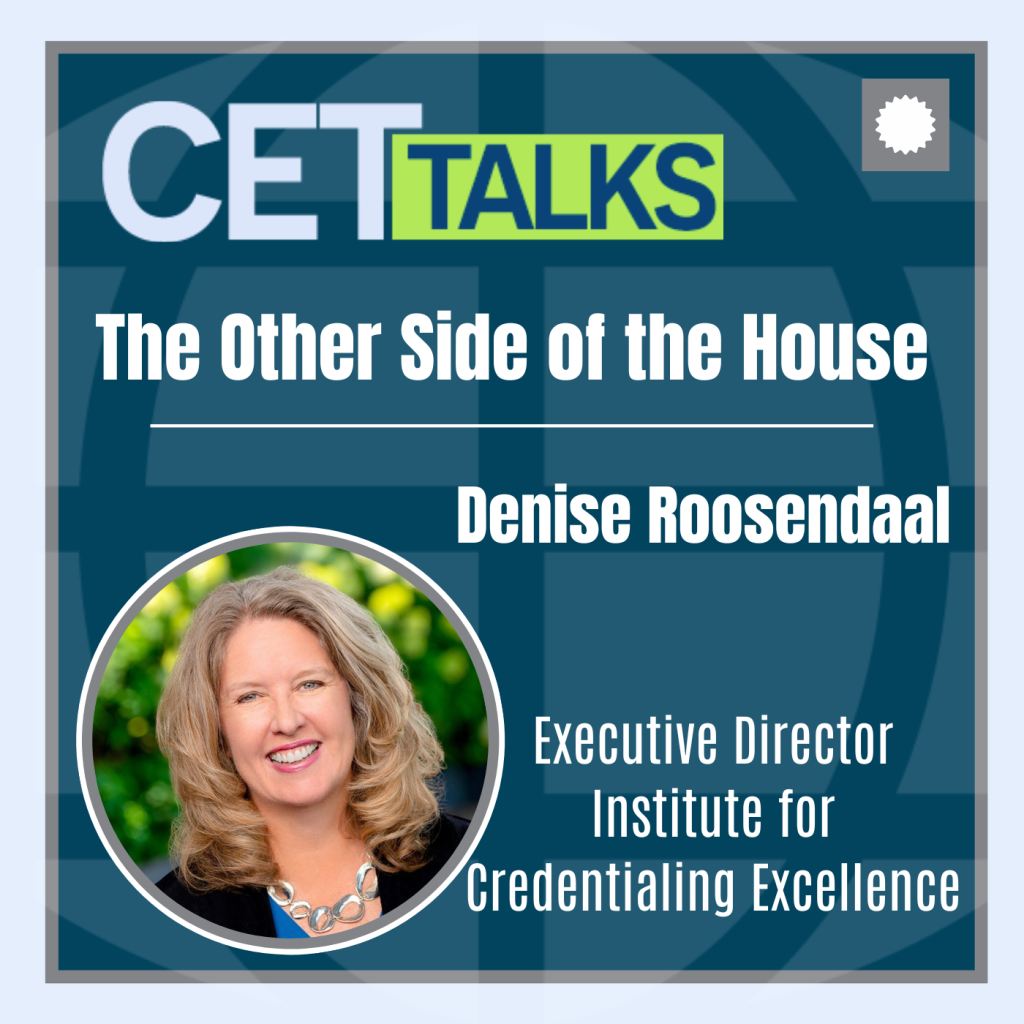
Tamiko Ogburn: Absolutely. Thank you. Today, we have Denise Roosendall, the executive director for ICE, which is the Institute for Credentialing Excellence. She brings over 37 years of association management experience, including 14 years leading ICE, where she advances innovation and public trust in credentialing. She was also recognized as an ASAE Fellow in 2022 and a certified association executive since 2001, with prior leadership roles in multiple associations, publications, and professional practice handbooks. She holds advanced degrees in public administration and creative writing and speaks nationally on credentialing foresight, professional standards, and learning ecosystem alignment. That’s an awesome background. Welcome, Denise.
Denise Roosendall: Thank you so much. Really appreciate it.
Randy Bowman: Denise, we’re so excited to have someone like you here to help us navigate this map and deepen our understanding of this world. For our listeners who might be in some of the same boats Tamiko and I were talking about earlier, can you give us an overview of ICE and how your work complements broader learning and workforce systems?
Denise Roosendall: Absolutely. Thank you so much. And thank you for that warm welcome. I really appreciate it. ICE is the professional home for certifying bodies, as well as organizations that provide assessment-based certificate programs. We call them ABCs. We have about 450 organizational members, including those companies that support certification programs, such as testing companies and consultants. Our members are 50% healthcare and allied health and 50% everything else, so financial services, construction management, and even association management. We are also the home for two accrediting bodies based on standards that we have built, the NCCA Standards and the ICE 1100 Standards. We like to think that we are raising the standards for all organizations that build and maintain certification programs, as well as assessment-based certificate programs. We are continually discussing best practices, as well as the future of credentialing in the long term, and ways to enhance assessment protocol. In those areas, our members are often thought leaders in the field.
Denise Roosendall: We have 322 accredited programs from a little over 130 credentialing bodies for NCCA. For the ACAP programs based on ICE 1100, we have approximately 20 accredited programs, but that standard is newer, expanding, and fitting an interesting and growing niche in the marketplace related to micro-credentials, which I know we’ll get to. I really appreciate your description of this ecosystem and how it evolves.
It is a little chaotic. I like to describe it as kind of a messy soup of entities, but there’s definitely change afoot as we think about the larger context, how we’re all working together, or in some cases, not working in concert. I feel like there’s room for us to align a little bit more closely. We are definitely playing a strategic role in that ecosystem through our research and data. We’re connecting with organizations in the higher education space, so we’re trying to think about what that role is and how we connect, as well as overall workforce development. I think we’re definitely playing a role there to say that there are quality standards for how you build and maintain a certification program to recognize the skills, knowledge, and abilities of the workers.
Tamiko Ogburn: That’s amazing! That leads me to a question. ICE maintains two important standards that you’ve discussed: NCCA for certification and ICE 1100 for certificate programs. How do these frameworks contribute to the quality, portability, and credibility of credentials across learning environments?
Denise Roosendall: Great question. I mentioned a little bit of the messy soup, chaotic environment that we’re in. I think one of the things I’ve noticed is that we also speak different languages and have different terminology for a variety of aspects and things that we work on. In our world, we think of credentialing as the umbrella term, certification as a term for recognizing the skills and abilities of individuals who have demonstrated that confidence through eligibility, as well as an assessment. And then there’s the certificate program, which is more oriented toward training and learning objectives. Those two standards are very distinct. NCCA is for certification programs, and ICE 1100 is for assessment-based certificate programs. By definition, accreditation is a marker of high quality because it uses a third-party analysis using standards built and used by the profession. In many instances, those standards and the accreditation that follows are often recognized by government agencies, licensure bodies, other certification programs, and higher education.
So, having that recognition, that third-party stamp of high quality, is a very important aspect of the value of an accreditation. You mentioned the variety of learning environments, and that’s a really interesting aspect of what the ICE 1100 Standards look at. They definitely allow for a variety of learning environments, and they require accreditation to articulate what that learning environment is, but we don’t prescribe one learning environment as being better than the other. We certainly see a variety through the application process. I can tell you that asynchronous online learning is the most popular for the programs that we have accredited.
I do think that there is certainly a variety of learning modalities that are important to recognize, and it’s important that we be flexible in our approach. And I’m talking about the ICE 1100 Standard and the accreditation process. We’re a bit agnostic on what is a preferred methodology, but rather recognize that a program needs to articulate what that learning environment is. You also mentioned portability, and I think that’s a very interesting aspect of what we do. There are a number of ways to look at portability. One is certainly reciprocity, especially in the licensure world, to be able to carry your credentials across state lines in different employment environments, as well as how they are treated and looked at by a number of stakeholders. However, I think it’s important to recognize that portability is important for the learner. To be able to use their credentials in a portable manner, to carry those credentials wherever they go, is an important aspect of what a learner is trying to demonstrate.
I think in the future, and in some cases now, portability means that the learner is carrying their verified credentials to the employer in things like a digital wallet or perhaps a digital badge so others can see what skillsets they have attained in their learning environments.
Randy Bowman: Denise, that’s so insightful, what you’re talking about there. So many workers have a skill stack, and no two skill stacks are exactly the same. It’s very important that they be able to take that skill stack with them and say, “These are my competencies. This is what I can bring to an organization in a portable and interoperable way.” Speaking of portability, within the CET ecosystem, there’s a growing interest in aligning microlearning, especially verified by digital badges or digital credentials, certificates, and certifications. How does and how can accreditation support this kind of structural clarity and learner mobility?
Denise Roosendall: I think it’s a really interesting and important trend that we’re seeing in the marketplace and driven by reality. We often refer to microlearning as snackable content, right? It’s that smaller slice of important skillset learning that should be recognized in the larger ecosystem. Certainly, the ICE 1100 Standard is becoming a kind of go-to standard for micro-credentialing. We recently accredited a stackable program for a health literacy organization with seven different domains, and this fit very nicely within the ICE 1100 Standard process. Each of these domains was then accredited, and how it works in the marketplace is that once a learner completes all seven and passes a summative exam, then that learner is recognized with a digital badge. There are so many terrific and creative ways that organizations are thinking about these smaller skill-based types of learning that need to be recognized in the marketplace, especially for employers.
The employer needs to be able to see and understand the variety of things that an individual applicant or current employee has attained and accumulated over time. We’ve built a resource for micro-credentials. We call it the micro-credential toolkit. We have case studies. We’ve done some survey data. We have a framework for building these micro-credentials, and we focus on phases. We think these phases are very important. The strategic planning part, getting an understanding of how these different structures and frameworks can fit together, and really understanding the imperative coming from the strategic orientation of the organization, the marketing, the operations, the design and development, delivery, and maintenance. We think there are important building blocks that still need to be considered when building these programs because you still want to build a high-quality program. I cringe when I see programs that are kind of slapped together and not taking into account these very important aspects, but I think the standards can act as a guide for people creating these new programs to make sure they’re not sacrificing quality in the name of expediency. They’re still important programs, and when built correctly, have a great uptick in the marketplace.
Randy Bowman: I agree and love hearing what people are doing in that space, and that the stackable credentials are becoming more and more popular. One of the things we’ve seen is that many certification programs require ongoing continuing education to maintain the credential. Are you seeing any innovation in how CEUs and recertification activities are being designed, delivered, or measured?
Denise Roosendall: Yes, that’s a really great question. Look, CEUs are the staple of recertification in our environment. We did a study back in 2020 on recertification practices, and it verified that, in fact, classroom time is the most stable, the most relied upon mechanism for enhancing education over time. That study also showed that the typical recertification time period is between three and five years, although it needs to be connected to the program in terms of what makes sense for a recertification timeframe. Also, the number of hours is somewhere between 30 and 60 CEUs in that renewal time period. So, those are some interesting statistics. We are seeing some innovations. Of course, portfolios have been around for quite a while, so that’s a great way of collecting the evidence of continuing competence, but we’re also starting to see longitudinal frameworks for recertification. This is the idea that you can feed a certificate some frequency of a question.
Let’s just say it’s weekly, so every week you feed a question through an app to a certificate that they answer. Then, over a 12-month period, they have accumulated a number of responses to these questions. This longitudinal approach is really interesting from the standpoint of how it’s delivered in a very time-sensitive world that we live in, but also what we can demonstrate over time that an individual is learning or not learning, where they need to focus their continuing education training. I do think that that’s something to watch in the future.
Tamiko Ogburn: So, that’s very insightful information. Thank you for that. The NCCA Standards emphasize maintaining a separation between certification and education. How should learning providers and credentialing bodies navigate that firewall while still collaborating within the same learning ecosystem?
Denise Roosendall: It’s a really great question and something that we have been grappling with for years. Lifelong learning is a powerful concept in today’s world, and I don’t think we can ignore that. We really have to participate in this concept that, over the course of one’s career, there should be learning opportunities to continue to enhance competence. And we may have done too good a job talking about this separation. It is critically important from a perception of conflict of interest that a certification program not only engage in prep material that is too integrated. They can do it. It is still possible for a certifying body to have under their roof some amount of pre-education opportunities or even test prep, but there have to be specific firewalls that ensure that there is not the tendency or the temptation to teach to the test because that degrades the integrity of the assessment.
So, making sure that internally there are different staff who work on these two components, as well as making sure that the governance is also separate, will help the organization resist undue influence between one governing body and another. We want a situation where we are keeping it clean and not exerting internal political pressure on the credentialing decisions. We want to keep that separate. There are ways to go about this, and we have a ton of resources on helping organizations see through this process, but that does not mean it prevents the idea or the concept of creating a long-term professional development pathway for lifelong learners. That’s a terrific way of approaching workforce development and individual learner progress over time.
Tamiko Ogburn: That’s a wonderful response. Thank you.
Randy Bowman: Well, Denise, I can’t believe we’re here already, but we’ve reached the time, and we always end our episodes by asking our guests this one question: What does a world that learns better look like to you?
Denise Roosendall: I love this question. And because I’m a learner myself, according to StrengthsFinder, I really love this question. I think in today’s world, there are restrictions on time and attention, so we are now learners on the fly. I think that accreditation and standards help to put safeguards in place to enhance that learning environment. That’s my practical answer, but let me give you my soapbox answer. I believe that a world that learns better has a workforce ready to engage in the demands of a rapidly changing landscape and the skill requirements that come along with that. I think a world that learns better has more productivity and fewer lapses in work due to workforce shortages or downtime for training. I think that a world that learns better and values the systems to support learning, frankly, means a more stable democracy and an engaged community. Not to be overly dramatic, but if I had a mic, I would drop it right there.
Randy Bowman: Yes. Yes, you would. That’s an incredible insight. Thank you so much for being here and for this delightful conversation that we’ve had today. To the listeners out there, I would say today’s conversation reminded us that accreditation and certification may live on different sides of the house, but together they are essential to trust, quality, and learning ecosystems. Denise has highlighted how ICE Standards, the NCCA, and the ICE 1100 provide structure, credibility, and portability, especially around microlearning and stackable credentials. As we explore how portability empowers learners to carry their skills across industries, innovation in CEUs is reshaping recertification. At the end of the day, it’s all about building this world that learns better, one that’s rigorous, relevant, and responsive to the workforce. Tamiko, what was your takeaway?
Tamiko Ogburn: I really loved this segment. I’m in the municipality space, and we’re moving in the future toward more workforce credentials. We’re looking at the ACAP and some other things because we know that our focus is primarily asynchronous learning in this environment. I love the fact that the municipality is exploring certifications, and that we’re able to learn about separating and making sure that there’s proper governance. You’ve mentioned all of those things with the ICE 1100 process, and so I’ve learned a lot here. I hope our learners have learned a lot about what to expect in the future when it comes to credentialing and certification.
Randy Bowman: As we close out, listeners, we would love to hear from you. If you would tell us, how do you see accreditation and credentialing evolving to meet the needs of today’s learners and tomorrow’s workforce? Feel free to leave your comments in the comment section below so we can hear from you. Also, don’t forget to submit your topic ideas, suggestions for guests, review our archives, and more at the CET Talks website, available at CET-talks.org. Don’t forget to subscribe to this podcast on your favorite platform so you don’t miss any episodes. Thank you so much for joining us today.
Host: You’ve been listening to CET Talks, the official podcast of IACET. Don’t forget to subscribe to the podcast on Spotify, Apple Podcasts, or wherever you listen to podcasts. To learn more about IACET, visit iacet.org. That’s I-A-C-E-T.org. Thanks for listening, and we’ll be back soon with a new episode.