Host: Welcome to CET Talks, the International Accreditors for Continuing Education and Training’s podcast, where we convene thought leaders in the continuing education and training ecosystem to share ideas, research, best practices, and experiences that promote the creation of a world that learns better. Enjoy the episode.
Randy Bowman: Hello, and welcome to CET Talks. My name is Randy Bowman, IACET’s president and CEO, and I’m excited to be here with our accreditation track co-host, Tamiko.
Tamiko Ogburn: Thanks, Randy. It’s great to be here with you today. So, I’m Tamiko Ogburn, and I’m one of the managers for learning and development with the City of Detroit. We’re also accredited with IACET, and I am a commissioner. I’ve been with IACET for about four years.
Randy Bowman: Thank you so much, Tamiko. It’s great to have you here. One of the things that IACET accreditation has shown me over the years is that no matter the field, people are learning everywhere, whether it’s city employees, site safety at construction sites, health and engineering, or even in the community management industry.
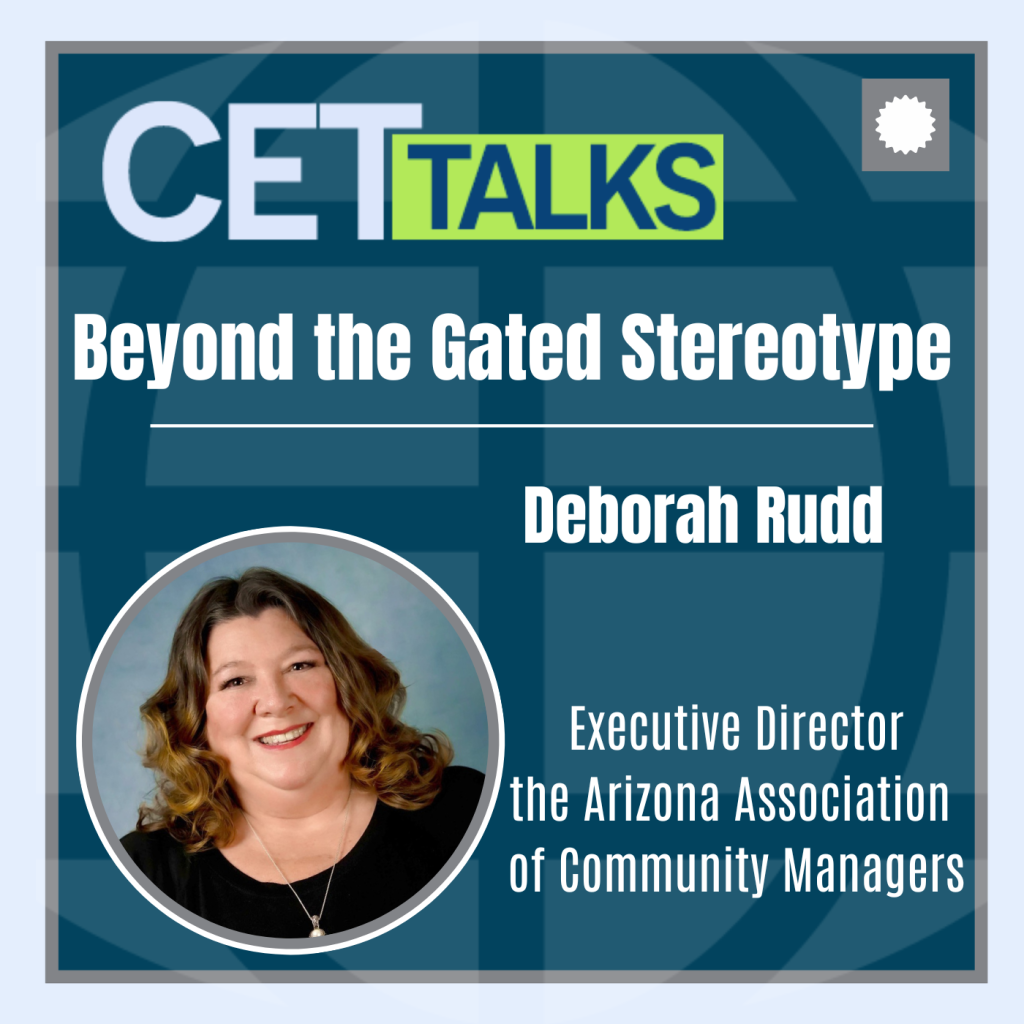
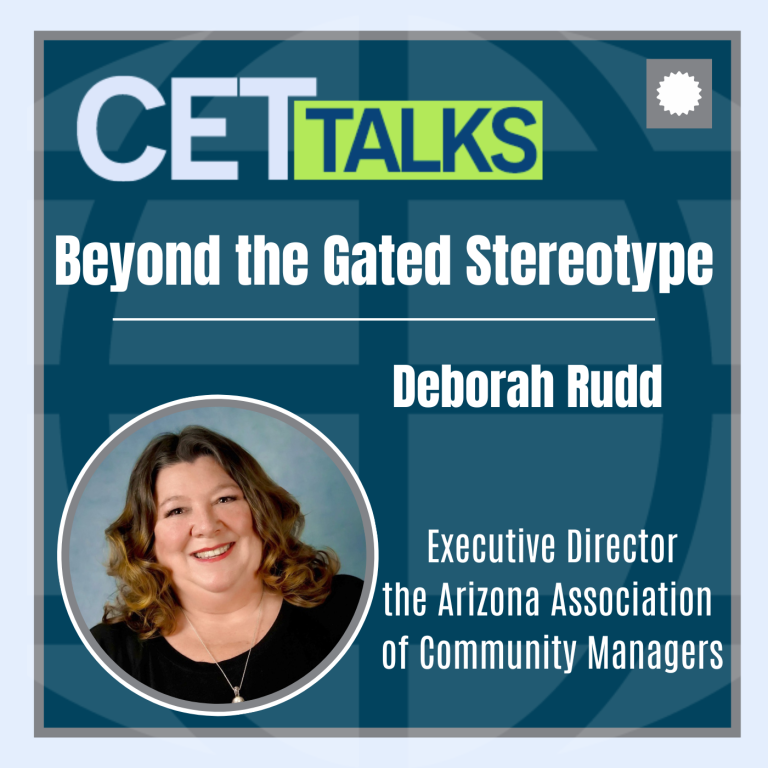
Tamiko Ogburn: Yes, today’s guest is Deborah Rudd. Deborah is the Executive Director for the Arizona Association of Community Managers (AACM). She brings over 22 years of community management experience with prior careers in law enforcement and real estate. She has been recognized with multiple honors, including the ASAE Award of Excellence in 2019 and the GEM Award for Community Manager of the Year, and AACM’s Heart of the Home for 2014. She leads legislative advocacy efforts in Arizona and champions continuous learning and excellence for community managers statewide. Welcome, Deborah.
Deborah Rudd: Thank you for having me this morning.
Randy Bowman: Well, we’re excited that you joined us. For our listeners who may not be familiar, can you tell us a little bit about the Association of Community Managers in Arizona and maybe the types of learners you serve through your training program?
Deborah Rudd: It would be my pleasure. AACM, or the Arizona Association of Community Managers, is a professional organization, and we’re dedicated to supporting and elevating the community management industry across Arizona. We’re one of the few that is state-specific. There is a national organization, but we like to specialize in just our state. Our members are primarily community management companies that employ community managers who are responsible for overseeing homeowner associations. They work closely with their board of directors to ensure effective governance and thriving communities. Through our training and education programs, we serve adult learners, starting at about the age of 19, and they go on up past my age. Some of them are very new in our community, starting out, and others are professionals who have been in our organization for quite a while. We’re looking to advance their knowledge and credentials, and that’s what our education classes do for them in our training program.
Deborah Rudd: They’re typically very busy. They wear a lot of hats. They’re single moms, moms with families. They’re young men just starting out in a professional organization. They’re all different types across the board.
Tamiko Ogburn: Thank you for that. So while associations aren’t new to our community, this may be one of the first community management associations we’ve ever had. What inspired your organization to pursue IACET accreditation? And was there a specific moment or challenge that sparked that decision?
Deborah Rudd: I have to say, my board of directors has been around for a very long time, and this has been a goal of theirs. They have asked for a long time to be accredited, to see what it takes, and they specifically asked for IACET accreditation. There were a lot of challenges with my predecessor, and they weren’t able to put everything together. In June, at our strategic planning meeting, I brought up that we should look at getting accredited. I think that we had the wherewithal to do it. The board emphatically agreed; they were so excited about doing it. So, we put our heads and noses to the grindstone, and by the end of the year, we were accredited. We were pushed by a board of directors that understands the professionalism, the rigorous training, and the standards that IACET has that we would like to match, mirror, and follow for our organization.
Tamiko Ogburn: Awesome. Congratulations on that.
Deborah Rudd: Thank you. I was excited.
Randy Bowman: Can you tell us more about what the accreditation journey was like for AACM, especially as the team wears so many hats and serves a highly specialized industry?
Deborah Rudd: Thank you for asking that. Actually, I have a very small internal team. I like to say we’re small, but mighty. We put on very large education programs and do very large events. I am constantly down at the Capitol with legislation all year. While our journey was definitely not a piece of cake, and we had a few bumps in the road, it was amazing. Part of that journey was looking at your standards and going, oh my gosh, this has been something we wanted to implement forever and didn’t know quite how to do it. Your rigorous standards allowed us to go in and look at everything along the way. It’s a love-hate journey for me. I loved it. The time was not hateful, but it was intense. Intense is a good word. We set very specific timeframes aside to concentrate on this.
Deborah Rudd: I’m proud to say that we accomplished it in five months, and that was just with us staying to our grindstone. Actually, I have to give a lot of credit to IACET. There were a lot of resources there to help me. Everyone was so kind. If I had a question, I could call or email, and they walked me through the difficult parts. It was an amazing journey, but no good journey is ever easy.
Randy Bowman: I’m glad the resources were helpful, and the staff was able to assist you. One of the things I heard from you is a message that I share when I’m talking to other prospective applicants—the intentionality you brought to it; it really is something. If you’re going to do it and succeed at it, you do have to block out specific time and work on that project. So, great. Thank you for being an example to others on how to do that.
Deborah Rudd: Well, it’s my pleasure.
Tamiko Ogburn: Thank you so much for that. To follow up with your accreditation success, how has accreditation changed the way AACM approaches training design, delivery, and evaluation?
Deborah Rudd: It has truly transformed my organization as we approach training, design, and delivery. It’s brought a renewed sense of excitement and purpose to our entire education program, from our adult learners, our instructors, and our education committee, which helps write the classes and does the investigation into the classes. They’ve all just been so incredibly excited. We’ve seen a higher engagement from our adult learners who appreciate the intentional structure and the consistency that the IACET standards give us. Our instructors have also shown a renewed enthusiasm for developing and delivering content and having a new method to do that. As adult learners learn quite differently, no one learns the same way. We’re able to have varied applications in our education classes, and everyone’s very excited to have their input in that. In addition to refining our policies and procedures, it’s made it easier to quickly identify areas for improvement and maintain a strong culture of continuous quality enhancements.
Deborah Rudd: One of our biggest shifts, I have to say, is collecting our feedback. Everybody wants to get out of a class, and I’m finding that our adult learners are now sitting there contemplating their evaluations and taking their exam seriously. When we are asking for feedback to make this better, instead of throwing all fives, because you’re all wonderful on the page, they’re giving it thought. When they don’t give a five, they’re saying, “We like this, but feel this could enhance this education class.” So with that, we’re able to immediately look at that. All of the evaluations go to my education coordinator, and then they come to me, and I read every single one of them. I look at their numbers, I read their comments, and then we do a course analysis. Then we take it back to our education committee and make those improvements in real time.
Deborah Rudd: It’s not putting it off to the end of the year or looking at it in totality. If we have strong feedback results, then we make those changes as they need to be made in our organization and in our education process. I have to say, our legislative body is so excited. We have our own professional standards that we abide by, but they’re so excited about our IACET accreditation. When they’re processing bills brought by constituents, they know that they can look at us as a resource for them to assist them with the bills and the knowledge behind them. That has to do with our education and the level of professionalism that IACET brings to us.
Tamiko Ogburn: That’s amazing. Thank you for sharing that.
Randy Bowman: That is exciting to hear. You’ve gone through the accreditation. What advice would you give another professional association or organization that’s considering IACET accreditation but is unsure if they’re ready or capable enough?
Deborah Rudd: Well, first of all, you are capable enough because IACET helps you in every aspect. They are there to help you, support you, and answer any questions. If you wait for yourself to feel like you’re ready, you’re never going to be ready. If you are contemplating making this change, go for it, go for it, go for it. Call me, and I’ll be your cheerleader all through the process. It’s important to do it. What you gain is just incredible. I can’t even express what this has done for our organization and what it will do for any organization. So, don’t hesitate. If you’re in that thought process, you’re ready to start, and there are so many references and resources to help you. And as I said, I’ll always be a cheerleader. You call me. I’ll help you.
Tamiko Ogburn: Aw, that’s very kind of you.
Randy Bowman: I want to go back to something you said at the start of our discussion. You mentioned that accreditation was something that your board was really interested in you pursuing, and IACET was a strategic goal of theirs. Can you give us a little more insight as to why they were interested in this? Just being totally transparent, we normally don’t see accreditation as a strategic initiative. It’s almost always operational, driven by the learning and development manager who understands why quality matters, and it’s something they have to sell to their leadership. How did it come from the top down to you?
Deborah Rudd: Well, this is very difficult on my heart to admit, but homeowners’ associations are kind of like the bottom of the barrel or a little lower than used car salesmen. I’m not quite sure why. Our job is to promote and support a homeowner’s association in accomplishing a very effective business. I have a board of directors of nine, and they’re all competitors. When they can come together as competitors and say, “We are trying to be professional. We’re showing homeowners associations that we can help you with everything that you do in a cyclical gear. That includes taking care of your landscape, your pool, your budget, your insurance, and doing insurance claims, running a meeting, and helping solve and mediate problems.” They understand that it requires not just Joe off the corner with no education.
Deborah Rudd: Education has been a very strong support for them, knowing that we need to transform just the overall outlook of what we do. We’re not the bad guys; we’re here to help them. And seriously, the only way to do that is education. I tell every new class going through their certification, it’s my pleasure to be there in front of them, and that when they walk into a boardroom, when they talk to their board of directors, they can confidently know that they’re the most knowledgeable and professional person in that room that can handle that business. That is through our education. My board was very excited and knew that we needed this level, and I cannot tell you how excited they are to have it.
Randy Bowman: That is so awesome to hear. We just really appreciate that.
Tamiko Ogburn: So here at IACET, we always like to end our podcast on one final question: what does a world that learns better look like to you?
Deborah Rudd: Boy, that’s nice. Well, let’s start with personal. I always feel like the day I stop learning is probably my last day on earth. We are better for learning every single day. And whether that’s something positive or something that was a great experience, but I don’t think I want to repeat that one. Without being constant learners, we stagnate. We can’t evolve. We can’t move forward. We can’t be the best positive, most knowledgeable person that you can be if we’re not continuing to learn. So shame on somebody who doesn’t look at everything that they do as a learning experience.
Tamiko Ogburn: I totally agree with that.
Randy Bowman: Debbie, thank you so much for this engaging presentation with us today. It’s been so insightful. I love how you talked about how continuing education has elevated not only your own internal operations, but has elevated your profession; that’s so exciting to hear. Tamiko, what was your key takeaway for today?
Tamiko Ogburn: Yes, I totally agree. I love the small and mighty team that Debbie has there and their high engagement in educating the homeowner agencies. It’s easier now to identify areas of improvement, now that you are accredited, and I love how it has enhanced your agency. That is what I took away from this. So, as we wrap up today’s discussion, on behalf of the gated stereotype advocacy education and heart of community management, we’d love to hear from you. What does community learning mean to you, and how does your organization foster education in unexpected places?
Randy Bowman: And don’t forget, you can submit topic ideas, suggestions for guests, review our archives, and more at the CET Talks website, available at cet-talks.org. Don’t forget to subscribe to this podcast on your favorite platform so you don’t miss any of these exciting episodes. Thank you so much for joining us today.
Host: You’ve been listening to CET Talks, the official podcast of IACET. Don’t forget to subscribe to the podcast on Spotify, Apple Podcasts, or wherever you listen to podcasts. To learn more about IACET, visit iacet.org. That’s I-A-C-E-T.org. Thanks for listening, and we’ll be back soon with a new episode.