Host: Welcome to CET Talks, the International Accreditors for Continuing Education and Training’s podcast, where we convene thought leaders in the continuing education and training ecosystem to share ideas, research, best practices, and experiences that promote the creation of a world that learns better. Enjoy the episode.
Randy Bowman: Hello, and welcome to CET Talks. My name is Randy Bowman, IACET’s president and CEO, and I’m excited to be here with our learning track co-host, Meghan.
Meghan Conan: Thanks, Randy. It’s great to be here with you today.
Randy Bowman: Awesome to have you. So, Meghan, I just recently stumbled across this fact that I can’t stop thinking about, there are more credentials floating around today than ever before, and yet public trust in credentials is lower than it’s ever been, and I just can’t get my mind around this kind of paradox.
Meghan Conan: It’s something I’ve been thinking about, too. Obviously, you know that I am a huge fan and proponent of credentials and digital credentials. I think we’re definitely struggling right now with the perception of validity with all of the things online and the flood of credentials into the marketplace. I think that’s really why the validation process of credentials is going to become so important in the future.
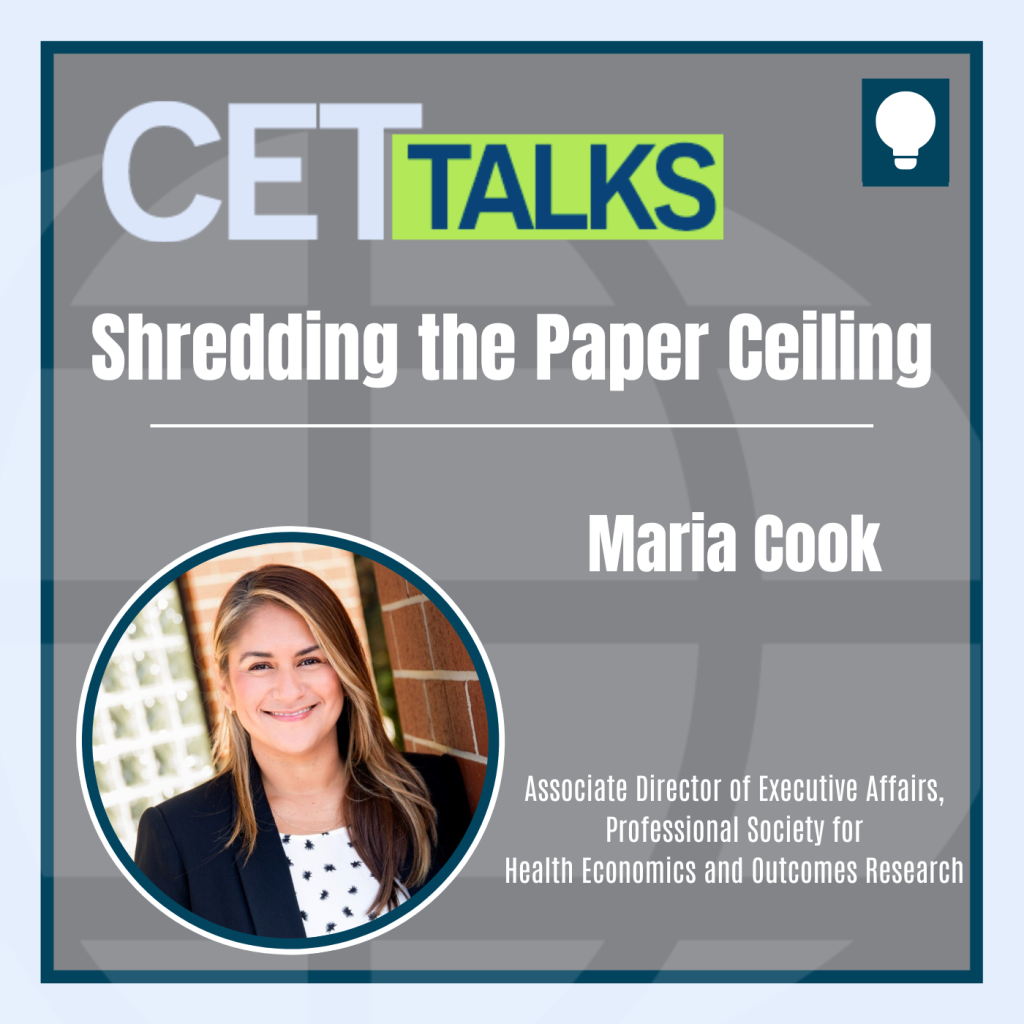
Randy Bowman: Oh, definitely, and that brings us perfectly to today’s episode. We’re going to be talking about shredding the paper ceiling and rethinking what workforce readiness means. Today’s CET Talks focuses on the non-credentialed workforce. I’m pleased to introduce you to Maria Jose Cook. She’s the associate director of executive affairs at ISPOR. That’s the Professional Society for Health Economics and Outcomes Research. While she’s been there for the past 13 years, Maria has worked all across the organization, extending responsibilities into strategic planning and operations, relationship building, and working cross-functionally across internal and external teams. She has demonstrated her commitment to driving her organizational success. Thank you for being with us today, Maria.
Maria Jose Cook: Thank you so much for having me.
Meghan Conan: We’re so excited to have you, Maria, and to hear more about this topic. So, question for you. As I was looking into this and thinking about your topic, what does ‘shredding the paper ceiling’ mean to you in the context of workforce development?
Maria Jose Cook: That’s a great question. Again, thank you for having me, and thank you for that wonderful introduction. I know folks at my job are probably going to laugh quite a bit because I do a lot, so I appreciate that. To me, the ‘paper ceiling’ means creating a workforce that values people for their lived experiences and their resilience and their real-world contributions, not just their resumes or degrees. As somebody who has worked their way up in a professional association world without the benefit of having a bachelor’s degree or any type of certification, I know firsthand what it means to be underestimated and have to work a little harder and compensate a little more because of what you don’t have. When somebody’s deeply capable in practice, it gets hard for you. I’ve been told that I won’t be able to manage people or get any further in my career without a bachelor’s degree, and yet I have been able to prove them wrong. Workforce development is about removing barriers that keep capable individuals, sometimes immigrants, sometimes first-generation workers, people who are paying for everybody’s livelihood in their home, and non-traditional candidates; it helps them be seen and heard and given a fair shot. I’ve seen how opportunity and belief in someone’s potential can change their life, and ‘shredding the paper ceiling’ is about expanding those opportunities for everyone, regardless of how they started.
Randy Bowman: A lot of what you were talking about were some of the things that we talk about here at IACET, when it comes to including people who are neurodiverse, who the traditional academic pathways may not be how they think, but they are incredibly brilliant and are an asset to any workforce. So, in today’s knowledge environment, there’s so much research and discussion around a society’s rejection of expertise, both at an individual level and at the organizational level. What do you say to the hiring authorities or leaders who say that employing non-degree or non-credentialed workers undermines an organization’s reputation?
Maria Jose Cook: First, full disclosure, I’m not an expert on workforce development. I’m just an expert on my life, and I’m an expert on advocating for myself and making sure that I am seen. If I’ve said this once, I’ve said it a thousand times; I feel that I am the Kool-Aid man in the sense that I come in a room, and I take over. I think that’s part of me demonstrating what somebody who doesn’t have a paper hanging in their office can do. If I were to answer your question, I would challenge that assumption, and I would challenge it head-on because, respectfully, it reflects an outdated definition of talent, and it’s a missed opportunity for innovation. I mean, an organization’s reputation isn’t built on how many degrees the staff has. It’s built on impact, it’s known for the strength of the culture of the organization, of whether the organization can stick to their values, their vision, their mission.
If it’s for thinking, a lot of the professionals that I’ve worked with, especially in the association world, they—and I’m doing air quotes—did not grow up in the association world. They come from academia, they come from corporate, and they want to change the way they see their job. Maybe it was too much pressure, but they bring a matched experience, emotional intelligence, and problem-solving skills that sometimes you don’t learn in a classroom. I’m a big advocate for people who know how to read a room. That is such an impressive skill to have—to read the room—and they don’t teach you that at school. I’m very proud of the way that I can read cues from my boss when he’s in conversations, and we have to move on from things. When you equate credibility with having credentials, you can limit access to individuals who have the talent but not the means. I was one of those individuals. I still am in certain ways. And today’s workforce, you demand inclusion and diversity and adaptability. Everything’s moving so quickly, and if you don’t adapt, then you’re behind. So, those qualities that are often carved by people who have to make their own path, and that path might be outside of school.
Meghan Conan: Maria, I think you hit it all right on with that response, and I think we can definitely see that in action now with the move. As you talk about workforce development, and even though you say you’re not an expert in workforce development—and I think you are by proxy—but what we’re seeing and hearing more in the L&D (learning and development) space is skills over certifications. Degrees that skills-based hiring and skills-based development is becoming more prevalent in today’s world, especially with folks looking at those, and how they can improve the skill sets of their employees over how they can give them added degrees. Since you’ve had experience personally with this, and perhaps with others in your organization or others that you’ve interacted with, can you share an example of a time when someone has succeeded, when they were given a chance, without a credential?
Maria Jose Cook: I don’t want to sound too full of myself, but I am a perfect example of somebody who was given an opportunity. If I can give you a short background story. Since I’ve been ISPOR for 13 years, I’ve had the opportunity to work with the founder, and then I worked for eight years with the previous CEO, and now we have a new CEO. With the previous CEO, I learned quite a bit regarding paying attention to detail. She was fantastic at that, and that’s something that, again, you don’t learn in the classroom. This new CEO, he’s fairly new. He’s been at the organization for about a year and a half, two years, and I think I am the person who works the closest with him, being the person who takes care of the executive office.
One of my core values is trust. I wanted to speak to him regarding my future. I felt a little bit stuck between four walls, and I spoke to him about how I don’t have the credentials, but I wanted an opportunity, and I wanted a shot to grow at a place I love. I love ISPOR; I love what I do there. I’ve been told, like I said before, that I was not going to manage people if I don’t have a bachelor’s degree, that I’m not going to be able to be a director. Somebody even said to me that not having a bachelor’s degree is going to haunt me for the rest of my life. I spoke to him about that, and he listened and assured me that not having a bachelor’s degree is not a deterrent for me to get hired in the company or any company.
We joked around—I joke a lot—and I said, I might not have a PhD, but I have a PhD at ISPOR because I’ve done quite a bit there. And because of his opportunity, because of the way that he has pushed me to get better and to learn more, I was able to apply for an executive leadership program that I got in on the first try; it’s a very coveted program through ASAE. I started to get out there. I started to feel more confident about myself. I started to shake hands and kiss babies, as I like to say. I also felt for a long time that I belonged in the room, and that is important when you don’t have certain credentials. My boss gave me the push that I needed, and here I am talking to you, lovely people, about my experience. That is a success; that is a big success.
Randy Bowman: Yes, it is, Maria, that’s a great story, and I love the leadership that your boss is taking in that, as well, to support you in your continued journey. So, it leads me to this question, and I’ve seen it, as well, in my experience, where non-credentialed people are really some of the hardest workers who know a lot, and you would be foolish not to include them in the conversations you’re having. How can organizations begin identifying those high-potential, high-functioning individuals who may lack formal credentials?
Maria Jose Cook: It starts with rethinking what a high-potential individual actually is. And I do air quotes once again for those listening. Instead of focusing on only degrees, organizations should focus on skills like adaptability, or, as I mentioned, problem solving, initiative. Sometimes, maybe you structure interviews and assessments to see what the person is capable of doing. You let candidates show what they do. And internally, if you’re looking to move people up the ladder, it’s about noticing who steps up, who leads without a title, who is a mentor, who the staff goes to for correct, hopefully, and proper advice whose staff looks to as a leader without having a manager title, and somebody that consistently delivers results. The great thing about organizations is that they do have the opportunity to bring up talent from within. It’s just a matter of them putting a scope in place for them to see what they’re looking for, but it is also about investing in those high-skilled individuals.
Meghan Conan: So, Maria, you mentioned in your response that you found a leadership program. I think that that’s an incredibly important thing for folks to find, especially individuals without degrees. There are a lot of professional associations out there that can help with skill development and career advancement. What role do you think these professional associations could play in helping to validate and amplify non-degreed learning?
Maria Jose Cook: Again, not an expert, just an expert on experience, a PhD in life at this point. To me, professional associations can recognize and elevate real-world experience through micro-credentials. I say this in personal experience, that’s the way that I have gone throughout. Now that I know what I want to be when I grow up, which is to work in the association world, they can recognize and elevate real-world experience through micro-credentials, skill-based certifications, volunteer leadership, and peer learning. Volunteer leadership is such an important part of workforce development and development as an individual. It helps you lead, it helps you run projects; it’s such a valuable experience. Associations can also provide platforms like conferences, publications, volunteer experiences, and committees where non-traditional professionals, like myself, can share knowledge, build networks, and be seen as subject matter experts. That visibility really matters because it helps to shift perceptions and create legitimacy around the diverse pathways that people take to get where they are. When you value learning in all of its forms, especially when it’s not just happening in a classroom, it happens in life. Professional associations can play a powerful role in opening doors, shaping futures, and building a workforce that is more inclusive.
Randy Bowman: Thank you so much. It’s been such a pleasure to have you here. As we wrap up, we like to ask all of our guests one last question and that is, what does a world that learns better look like to you?
Maria Jose Cook: You mentioned non-traditional learning. I have a son, he’s 10, and he is a non-traditional learner, and I do think and worry about him a little bit in the future because he’s a really, really smart kid. He just learns differently than other people. So for me, a world that learns better is one where opportunity is accessible to everyone who seeks it, especially those who are traditionally left out. It’s a world where organizations don’t just value formal education, but create meaningful pathways for growth, for learning, provide shots to people that might not have had them in the past because of socioeconomic reasons, because they have an accent. Maybe they didn’t speak English until four or five years after they came to this country. It means embracing curiosity and welcoming challenge and investing in potential, no matter where it comes from. A world that learns, it’s a world where you give people a shot.
Randy Bowman: Thank you so much for delivering an engaging and informative presentation for us today. The thing I’m taking away probably the most is the idea of reframing what potential looks like, and looking for those skills like initiative and adaptability in your workforce. Leaders who are building strong organizations are going to be encouraging those non-credentialed, but hardworking people, to go and get other credentials, whether they’re micro-credentials or to go to other programs to continue to sharpen those skills. So, I think that’s a great takeaway for us. Meghan, what’s your takeaway for today?
Meghan Conan: Honestly, Randy, I definitely agree with everything that you said, but I’m going to look at this from being a people manager myself, and taking a look at the folks that I’ll be adding to my team currently and in the future and taking a look further into their skill sets, their life experience versus what degrees they’re bringing to the table. I think it’s a very valuable thing for managers to keep an eye on and to be mindful of when they’re doing hiring and when they’re looking at promoting individuals within their organizations; education isn’t necessarily going to give the best candidate for a position. Someone may have the skill sets and the experience to be able to do the job in the same capacity, if not better. So we shouldn’t just pigeonhole ourselves into looking at degrees, rather than skill sets. So thank you, Maria, for all of your insights. It’s definitely given me and, I think, a lot of others some things to think about. As we wrap up today’s discussion on growing the non-credentialed workforce, please remember that we’d love to hear from you. How do you or your organization view the role of credentials in today’s workforce? Do you think they’re a must-have, or do you think you and your organization are ready to go beyond the paper ceiling?
Randy Bowman: And don’t forget, you can submit topics, ideas, suggestions for guests, review our archives, and more at the CET Talks website, available at cet-talks.org. Don’t forget to subscribe to this podcast on your favorite platform so you don’t miss any episodes. Thanks so much for joining us.
Host: You’ve been listening to CET Talks, the official podcast of IACET. Don’t forget to subscribe to the podcast on Spotify, Apple Podcasts, or wherever you listen to podcasts. To learn more about IACET, visit iacet.org. That’s I-A-C-E-T.org. Thanks for listening, and we’ll be back soon with a new episode.