Host: Welcome to CET Talks, the International Accreditors for Continuing Education and Training’s podcast, where we convene thought leaders in the continuing education and training ecosystem to share ideas, research, best practices, and experiences that promote the creation of a world that learns better. Enjoy the episode.
Randy Bowman: Hello, and welcome to CET Talks. My name is Randy Bowman, IACET’s president and CEO, and I am excited to be here with our leadership track co-host, Mike Veny.
Mike Veny: Hi Randy, and hello to our listeners out there. My name is Mike Veny. I’m the co-host of this lovely track, and I am the CEO of an IACET-accredited provider. Randy, you just announced yourself as CEO, but when I met you, if I’m correct, we met in 2021. I was giving a keynote at the IACET conference, and you were the IT guy, right?
Randy Bowman: Yes. My background is actually information technology software development, and I dabble in AV.
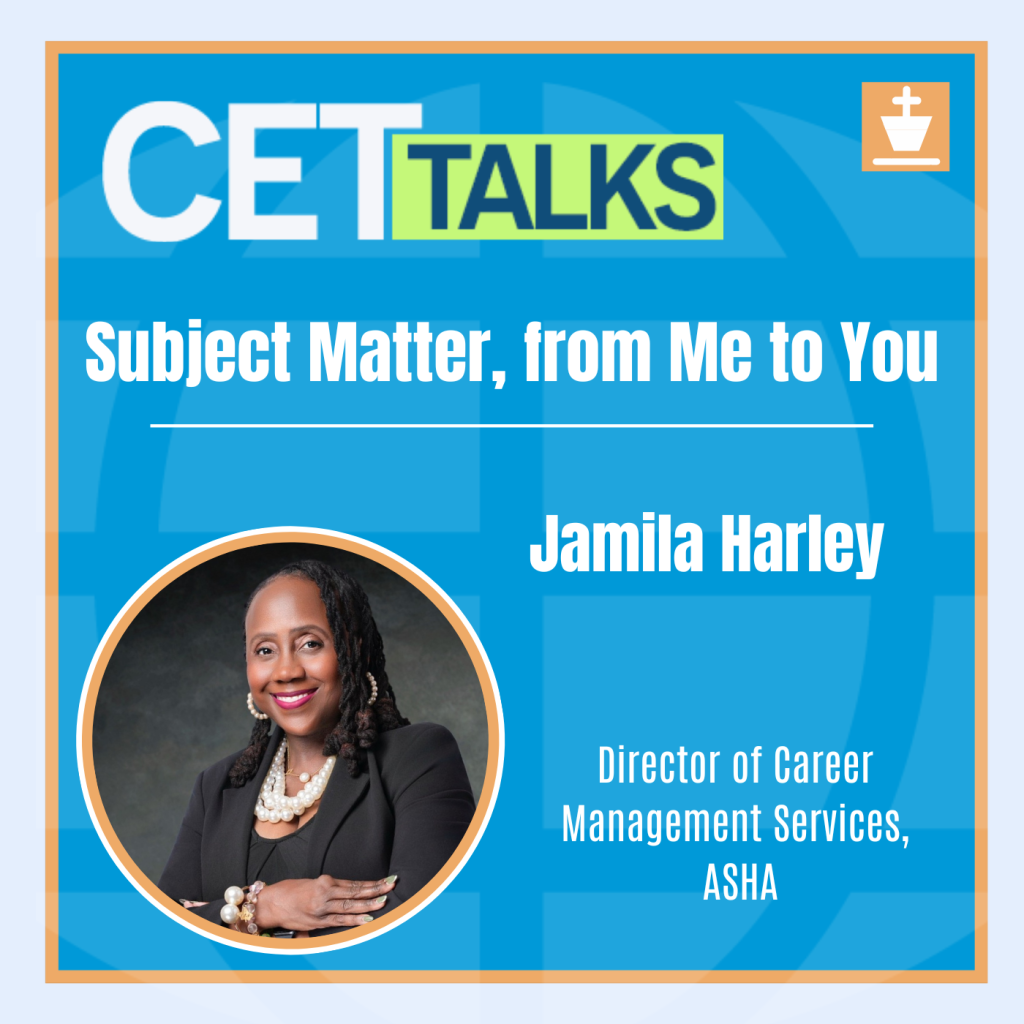
Mike Veny: You dabble in AV. You have had an interesting trajectory to get to CEO, and one of the reasons I’m really excited about today’s show is because so many people that are out there have these non-linear career journeys. If you are a listener out there, and you’re a leader leading a learning organization or you’re aspiring to lead a learning organization, this is an episode you really want to listen to. Today our guest is Jamila Harley, the director of career management services at ASHA. In her role at ASHA, which is spelled ASHA and stands for the American Speech Language Hearing Association. Jamila oversees content recruitment, advertising and sales, and fiduciary operations of ASHA’s career portal. In addition, Jamila herself is a speech language pathologist (SLP), and she maintains those credentials in her association management journey. Jamila, welcome to our show.
Jamila Harley: Thank you so much for having me. I’m excited to be here.
Mike Veny: So you’ve made several professional pivots here from learner to subject matter expert to association management professional, to leader in support of your subject matter content. Can you tell us where this all began and a little bit about your journey?
Jamila Harley: Sure. Well, as you mentioned, I am a speech language pathologist, which was also a bit of a transition for me. I was a non-traditional student. I didn’t graduate until I was in my mid-thirties, so not long ago—I’m just kidding. So, I’ve been a speech language pathologist now almost 20 years, which is hard to believe. But my journey started there because I had experienced how beneficial speech language pathologists were with a family member, and I was introduced to the field. After a little journey through graduate school, I started working as a clinical speech language pathologist, and I did that for about three years before I was tapped for leadership. I was a staff SLP, and then I was tapped for leadership because I was looking for a job, and I had done all this volunteerism and someone reached out to me, and they wanted to interview me for a position with a skilled nursing facility.
They had found my resume online and I was like, “You want to interview me? I’ve never worked in a skilled nursing facility; I’ve never been a rehab director. Like why?” Once we got to the interview, he was like, “I can train you, but you have leadership experience, and that’s what I really wanted. I could train you on the other aspects of the job, but what I really want is someone who has the leadership acumen.” That was my first foray into leadership professionally. I worked as a rehab director for seven years before I came to ASHA. Again, based off of the things that I was doing in my role as rehab director and also some of the things that I did as a volunteer and having an expansive network throughout my professional associations, especially the National Black Association for Speech Language and Hearing and several committees with ASHA, I was able to make that transition from a clinical speech language pathologist into an association executive.
When I moved into my first role at ASHA, it was actually supporting other SLPs who worked in environments that I previously worked in, who worked in healthcare environments. I did that for about two and a half years and had a mentor at work. I reached out to someone who had accomplished a lot of the things that I wanted to accomplish. I just asked her, “ Hey, would you be willing to mentor me or serve as a peer mentor?” She was agreeable to that, and maybe a few months into our mentor-mentee relationship, she informed me that she was moving to another position, and she suggested that I apply for her role, which is the role that I’m in now. So, I would say it’s been a little bit of luck being in the right place at the right time and having really strong peer and mentorship connections that really helped me to make these different transitions and moving into leadership.
Mike Veny: Wow, that’s a lot right there. I just want to take something you said that I think is so important. First of all, I want to ask if you could answer how you navigated these transitions. That’s a lot of transition right there, but something you brought up that’s so important for our listeners, is a mentor. I just wanted to ask you to elaborate a little more on how that helped you with transitions and how anyone listening can go about finding a mentor, if they’re going through a transition like this.
Jamila Harley: Mentorship has been key for my trajectory because one, I think a lot of times when people think of mentors, they think someone who’s kind of been where they want to go. But a lot of times my mentors have been peer mentors who have encouraged me and said, “Why don’t you apply for it?” Actually, the role that I started in at ASHA, I found out about it from a peer and she said, “I think you could do this. I looked at it, I see what you’re doing, volunteering and leadership that you do in the profession. I think this will be the perfect role for you.” Then I reached out to another mentor who was ahead of me and talked to them about this opportunity and what they thought; did they think that I would be a good fit? I shared my resume with them and some of my personal goals, and I was encouraged to take the leap.
And, of course, I had a supportive husband who was willing to move from North Carolina to Maryland with me in order to take on this position, but it was mainly just having the support of mentors throughout, from a student, even to now. If you’re looking for a mentor, I’ve found mentors through service, basically serving my profession, serving on committees, just volunteering and giving back, and you meet other people. Usually, if you’re volunteering in a specific area, you’re going to meet like-minded people. So for me, that’s how I found my mentor. Now, I know there are some formal mentorship programs, depending on what’s offered in your profession. I have participated in a more formal mentorship program because I was moving from a speech language pathologist to my role now in marketing and sales. I’m not trained as a marketer, but what I brought to this position was, because I am a speech language pathologist, I was able to bring that subject matter expertise and empathy into the role, and then also just the experiences that I’ve had as a volunteer. I brought my whole self to the position. I think that’s really important when you are transitioning, whether it’s across industries or maybe you’re wanting to move from a staff level position to some type of leadership role; it’s important to bring your whole self. Maybe you haven’t led in your official capacity at work, but have you led in a volunteer organization? Do you lead in your community? So, all of those things matter, and I just made sure that I brought my whole self as I approached each of these transitions.
Randy Bowman: What an inspiring story Jamila I’m in awe. Obviously though, even as you’re making these transitions, there’s always challenges. There’s always obstacles. Can you talk a little bit about some of the challenges you did face in building credibility while still learning the ropes of some of your leadership positions?
Jamila Harley: I’ve been really fortunate, especially at ASHA, because ASHA has a model of coaching. So instead of having a manager, a supervisor, a boss, you have a coach. I’ve been fortunate to have really good coaches who made sure to invest in me. When I first started at ASHA, my coach, she instantly asked me, “What do you want to do next? I see what you’ve been doing. I know you’re going to be great in this role, but I see you doing something else in another five years. What are your goals? What do you want to do?” We talked through a lot of those, kind of brainstormed what I was thinking about. One of my first goals was to earn the CAE because I learned about it once I started working at ASHA. I felt that that would help me learn more about association management. It also gave me more credibility because I am a speech language pathologist, and I don’t have a long tenure in association.
So I set out a goal and praise God. Thankfully, I did R-M-I-C-A-E this summer; I had a five-year goal set out to do that, and I was able to do that. I think that will also help me as I move forward. That was a part of it, but also being willing to admit where I had some opportunities to learn and having really good coaches who are willing to invest in me. I came from a background where I did manage teams, but managing teams and coaching teams is very different. So my coach, she invested in executive leadership training for me. That was another way that I built credibility with my team, which is a small team—learning how to build trust with them, learning how to coach them, as well, and being really responsive to any feedback that I receive.
Another help for me was because I am moving into an association where I already had strong credibility as a subject matter expert, as a speech language pathologist. I have plenty of people speaking very highly on my behalf, and I always tell mentees and people who come to me and ask for advice, the world is smaller than you think it is, especially when we work in these really niche industries. Always make sure you leave a good impression. We all leave an impression; just make sure it’s a good one. So when people say, “I’ve heard of you” it’s not like “I heard of you.” It’s like, “Oh, I’ve heard really great things.” That has really helped me and having mentors.
And something I had never heard of before, and as I reflect, I realized that I was privileged to have this, is also having sponsors; people who are willing to open doors for you, people who willing to speak your name in rooms and talk you up. But I think you have to already have invested in yourself. So, while I wasn’t an association executive, I had done a lot in our profession. I had given back a lot, I had done a lot of leadership-type activities, and I had gone through leadership programs. All of that I think really helped me. It wasn’t as challenging of a transition as it could have been. Right now, I would say the biggest challenge for me is shifting my mindset now that I’m a member of our organization, but I’m also now a leader behind the scenes, and I have to be that I kind of have to figure out how to do both. As associations, we’re here to help and serve our members, but I also have to remember that sometimes making those strategic leadership decisions has to be what’s best for the association as well, and not just for the member.
Learning how to compartmentalize can be a little challenging, but I also think it’s a superpower. I can have that empathy, as well, when I’m making those decisions and people come to me and I’m like “I can’t speak for everybody, but these are the things I’m hearing; these are the things I’m seeing; this is how I might feel if it were me.” I use that to my advantage in my current role. Continuing professional development, I think, has helped me build up my confidence and be able to demonstrate myself as a leader in various conversations.
Randy Bowman: Thank you. What would you say is one trait or skill that you picked up as a speech language therapist that you brought into management and leadership that would not traditionally be considered a management skill?
Jamila Harley: I would say the biggest thing is learning how to build rapport and trust quickly, because you can’t lead people if they don’t trust you. You can’t get them to buy into your vision if they don’t trust that you have their best interest at heart. So for me, that was one of the biggest accomplishments when I moved into my role because again, I’m not a marketer, I’m not a sales person, and I’m coaching a sales salesperson. It took us a minute to navigate that journey and build that trust, so that he knew that we are a team. And I believe as a speech language pathologist, you’re having to do that all day. You’re constantly walking in to meet a new person and having to build that trust and rapport with them in order to get them to partner with you to work towards their goals.
Mike Veny: Wow. Thank you. By the way, you should just totally take the transcription of this interview and start outlining your book. This is a lot of information right here. So, to the leader that’s listening who is not following the traditional path, how do you define success?
Jamila Harley: Success is personal, and I think success looks different for different people. For me right now, what success looks like is when my members call me and say, “I really appreciated that resource that was developed or that program”. Or they reach out to me, and they want me to help them with their students who are trying to make that transition from a pre-professional, which is what I call students, pre-professionals to professional. So, when I’m asked to speak and still serve as a subject matter expert, not just on specific topics necessarily, but also inspiring the next generation of what success could look like for them. For me right now, that’s what it looks like. Or when members reach out, and they want to collaborate with us and contribute to content or programming because they’re impressed with what we’re doing. They want to engage and help us continue to build on this and build the confidence in another SLP who might want to follow a non-traditional path.
So for me, I just look at it as associations. We’re here to solve problems, we’re here to help our members achieve their goals. I don’t want to say it’s been an easy transition, but the thought process behind what we do is similar. So for me, I’m doing something similar in the sense I’m helping people achieve their goals. It’s just that I’m now working with peers instead of patients. But I think you have to decide for yourself, what does success look like to you? For some people success means they made it to the senior leadership role, or that they survived that week. Especially when we’re dealing with membership-type associations, you’re dealing with members and things are changing constantly in our environment right now. Sometimes, it’s just getting to the end of the week, but I think setting goals can be helpful if you are looking to redefine what success may look like for you. Like I mentioned before, I set a goal to get my CAE, and I accomplished that. So to me, to move from being a speech language pathologist to now redefining and branding myself as an association executive and doing that by earning my CAE, speaking at conferences, being asked to speak, being recognized more, that’s success for me right now.
Mike Veny: Well, what you have been saying, and I just want to amplify this for those of you listening, it’s not even just setting goals. I feel like it’s short or medium term goals, not necessarily long-term goals; not super short, but somewhere in the middle. But let’s just say I know about setting goals, I know about defining success for myself, but I’m a continuing education and training professional, and I’m stuck. What would you tell me about how to take a next step?
Jamila Harley: So, I can relate to that. That’s how I felt before coming to associations. The more people I met, the more I realized we all have these really interesting pathways into associations. A lot of us fell into the industry. I want to back up and say one thing. In January of 2019, I was talking to one of my mentors and she was asking me, “Well, how are things going? How are you liking your job?” And I was like, “To be honest, I’m not really happy anymore.” I explained my different reasons as to why. I was like, “I’m trying to figure out what I want to do next, but I’m not really sure.” And she was like, “Well, if you could do anything in the world, what comes to mind right away?” And I was like, “I would like to work at ASHA.” I just said this out of nowhere. It was rooted in my volunteer experiences, and I thought it would be really nice if I could give back to my peers and work in a different way. And she was like, “I think you’d be great there.” Well, fast forward, and by August of that year, I was being offered a job at ASHA.
So, for me, I think the first thing is just to be honest with yourself. Why are you feeling stuck? I suggest doing some deep introspection as to what you’re dissatisfied with. I know we talked about goal settings a lot, but you do have to think about not just your professional goals, but what are your personal goals? For me, I have a chronic health condition. So, one of my goals was to get to a role where I didn’t have to stand up all day because I have mobility issues, and I have issues with my immune system. I knew I needed to move out of that particular environment, but I wasn’t sure where I wanted to go. Then I started thinking about what are my skills that might be transferable into different roles?
Then, I started thinking about the things that I’m passionate about, the things that I’m naturally good at, and I also really leaned into my circles of support. As I mentioned, that’s mentors, peer mentors, and family and friends. Think about having those conversations with them and about what they see, because sometimes you don’t see yourself the way others do. I definitely would start with some introspection, and then lean into your circles of support. After that, if you’ve have been able to identify a role, then what are some additional trainings or education that you might need? Or maybe you need to expand your network. Do you need to make some more connections? Are there some leadership skills that you need to develop? Can you reach out to someone and do an informational interview and find out how do they like their role and how did they get there? What was their pathway there? To me, that’s the hard part. If you’ve done all of that, then you just have to have confidence in yourself, be willing to take a leap and be willing to hear “No.” Don’t be afraid. As high achievers, a lot of times we never want to hear “No,” but sometimes that “No” can give you insights into what your next steps might need to be or where you need to level up. So, you have to be willing to bet on yourself and believe in yourself.
Randy Bowman: Wow. Thank you so much, Jamila. There is tons of great content here today. As we wrap up, we always like to ask one last question of our guests, and that is, what does a world that learns better look like to you?
Jamila Harley: I think in order to have a world that learns better, we have to make sure we have a world that has equitable access to learning. Sometimes those barriers to access might be rooted in socioeconomic differences, ableism, or it might be generational differences. Like I’ve mentioned before, I’ve been really, really fortunate because I have a very supportive organization that has been willing to invest in me to have learning opportunities that I probably would not have been able to have on my own. Executive coaching is not cheap. Going to some of these conferences is not inexpensive. So having that support financially to be able to do that, and through ASAE DELP (Diversity Executive Leadership Program), because I’m also a DELP Scholar, that has allowed me to take advantage of opportunities that I may not have been able to because financially it wouldn’t have worked for me or because there’s kind of this glass, I don’t want to say ceiling, but like an invisible wall.
If you’re not at this particular level or you don’t have this particular title, then you are not able to access this learning. Through this program, I’ve been able to be in rooms that I may not have been in with other CEOs and senior leaders, and I look at that as a privilege, because I know everyone’s not going to get that opportunity. Also, I think just understanding that there are different styles of learning and assessment. I think embracing that is also as important to the learning is how that learning is assessed and recognizing that not everyone learns the same. Not everyone can be evaluated the same for what they’ve learned. Also, making sure that learning is more rooted in critical thinking than memorization, and that it’s rooted in community and learning together.
Randy Bowman: Thank you. Thank you so much for delivering an engaging and informative presentation today. I know I learned so much. I think one of my key takeaways is about serving and volunteering and being open to those opportunities is a pathway to success, to move from subject matter expert to leader. I’m just appreciative of you taking the time to share your story and your experiences with us today. Mike, what are you taking away from today’s conversation?
Mike Veny: I’m taking the same takeaway as you actually, about volunteering. And to those of you listening, IACET is an incredible organization to be a part of, an association that you can volunteer for. We need volunteers. And I think of myself actually, as Jamila was talking. I’ve gotten so much out of volunteering to do things for the organization, and so it really, really works. It’s a great way to get out of your own head, at the very least, and do that. So, as we wrap up today’s discussion on going from subject matter expert to leader, we’d love to hear from you. We want to know about your learning journey. How has your learning journey changed or how is it changing? Did you go from subject matter expert to leader, or was it the other way around?
Randy Bowman: Don’t forget, you can always submit your topic, ideas, suggestions for guests, and review our archives and more at the CET Talks website. That’s cet-talks.org. Don’t forget to subscribe to this podcast on your favorite platform so you don’t miss any episodes. Thank you so much for joining us today, and we’ll see you next time.
Host: You’ve been listening to CET Talks, the official podcast of IACET. Don’t forget to subscribe to the podcast on Spotify, Apple Podcasts, or wherever you listen to podcasts. To learn more about IACET, visit iacet.org. That’s I-A-C-E-T.org. Thanks for listening, and we’ll be back soon with a new episode.